Facebook Twitter Instagram

Mental health trauma is the unseen side of domestic abuse

Women who experience domestic abuse are twice as likely to experience depression as those who don’t.

UNiTE to End Violence against Women is an annual campaign led by the UN. The campaign kicks off on 25th November – the International Day for the Elimination of Violence against Women – and runs until Human Rights Day on 10th December.

Most violence against women is committed by the woman’s husband or other intimate partner.  It happens in every country across the globe; 1.4 million women in the UK experience domestic abuse each year and, on average, one woman is killed by a male partner or ex-partner every week.

However, even more worrying are stats from the UK’s police chiefs – which point to more women affected by domestic abuse taking their own lives than were murdered by a partner or former partner. Yet there is very little awareness of or discussion around what is arguably a secondary and largely invisible impact on women.

That’s where organisations like Woman’s Trust come in. Set up almost 30 years ago, Woman’s Trust has an exclusive and specialist focus on providing free mental health care to address the trauma caused by domestic abuse and the effect this has on women in their daily lives – often going undiagnosed for years, sometimes even decades after the relationship has ended.
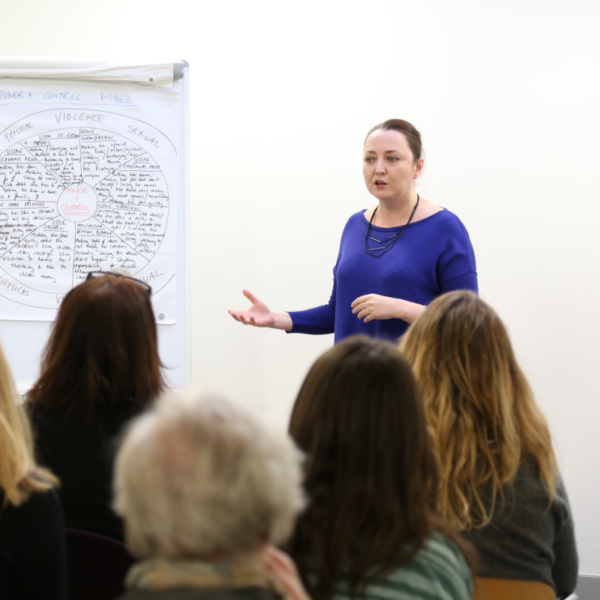
Woman giving talk on domestic abuse to other womenWoman’s Trust has received a number of grants from us since 2012. The London-based charity has supported tens of thousands of women with free therapy and counselling and has been a literal lifesaver for women at some of the most desperate times of their lives.

A client of Woman’s Trust shared, “My experience getting help and support from Woman’s Trust was invaluable. I was not in a good place and didn’t know that I was in an abusive relationship for all those years and what was abusive about it. When it’s psychological abuse, it’s very difficult to decipher. WT helped me to see things and to understand what was happening to me, which made me understand why I have been feeling so depressed for so many years.”

Rachel Prescott-Smith is Head of Fundraising at Woman’s Trust. She told us, ‘‘Domestic abuse still carries shame and stigma (which it shouldn’t) and as a result, many women don’t like to talk about it, and worryingly some don’t even recognise their experiences as abuse. Most people also don’t really consider the resulting trauma and mental health issues that experiencing domestic abuse can cause, even though one in two women’s suicide attempts are linked to their experiences of abuse. Raising awareness is so important, as it helps survivors know they are not alone, and that help is out there.”

According to Rachel, there are still many misconceptions around domestic abuse, from what it entails to how likely it is to happen and the way it affects survivors on a practical and emotional level. Many people don’t realise that the term ‘domestic abuse’ covers a wide range of abusive behaviour, from physical violence to economic control and psychological abuse.

Women who experience domestic abuse are twice as likely to experience depression as those who don’t, and it can take a long time to process the trauma – or even recognise that mental health challenges are caused by domestic abuse. Counselling is invaluable, but it’s difficult to access on the NHS and even more rare to get specialists who understand the unique ways in which survivors are affected, which is why charities like Woman’s Trust are so important.

Rachel shares, “If you’ve experienced domestic abuse and live in one of the areas that we work in, we can offer you up to 18 sessions with a counsellor. You’ll see the same counsellor, at the same time each week, so that you can build rapport and feel more comfortable. Sessions are completely confidential and can be online or face-to-face in a women-only setting.”


Get support

If you’re experiencing (or have experienced) domestic abuse, and you want to find out about counselling sessions in London, contact Woman’s Trust on:

(Office hours: Mon-Fri, 9:30am – 5pm)

If you want to make a professional referral for someone under your care or supervision, call Woman’s Trust on 020 7034 0303.

For immediate advice or support, please call the National Domestic Abuse Helpline on 0808 2000 247.

Angelou is a partnership of West Central London services that support women and girls affected by domestic violence and abuse. You can call Angelou for free on 0808 801 0660, email angelou@advancecharity.org.uk or visit www.angelou.org to find out more.

If you’re a man experiencing domestic abuse, call Respect’s Men’s Advice Line on 0808 8010327, email info@mensadviceline.org.uk or visit www.mensadviceline.org.uk. The ManKind charity can also help you to escape an abusive situation.


Flats are now available in our almshouses

If you think you might be eligible, we'd be happy to give you a tour of our almshouses and share what it's like to live here.

Read More ...
Children in a classroom. They appear to be interested in what the adults are saying. One girl has her hand raised.

Lawyers4Learners

Helping children become more confident at speaking up

Children in a classroom. They appear to be interested in what the adults are saying. One girl has her hand raised.Communication is a crucial life skill. Being able to calmly and confidently get your point across is vital throughout life – in school, workplaces and with friends and family members. What’s more, as Louise Jones, Director of Lawyers4Learners, says, “Children who can articulate their feelings are better equipped to stand up for themselves.”

Lawyers4Learners runs workshops with Year 6 children across Hammersmith. Over four sessions, children take part in mock trials designed and led by volunteer lawyers. As well as becoming more confident at speaking in front of people, the children learn critical thinking, debating and negotiation skills. One child said of the programme, “At the beginning, I probably needed a bit of persuading to get up there, but now I wouldn’t give it a second guess if someone asked me. I would just go up there and I’d start speaking.”

Louise launched the charity with barrister Caley Wright. The pair saw the gap between what was being offered in state schools compared to private schools. Louise adds, “There can also be a big gap between state schools in different areas. The schools we go to are usually under resourced. For lots of the children, English isn’t their first language and there aren’t many opportunities for them to practise any kind of formal speaking. The teachers are doing a brilliant job at doing the things that have to be done, but there isn’t much time for extras like public speaking.”

Louise and Caley realised that lawyers, who are skilled in oracy, argument and persuasion, could help to close the gap. They trialled Lawyers4Learners in five schools. Two years later, the charity is already working with 24 schools. It’s aiming to reach 45 by the end of this academic year, benefitting 2,000 children, including 330 in Hammersmith.

To realise its ambition, the charity has accepted a £5,000 grant from Hammersmith United Charities. Louise says, “We rely heavy on grants. Without the HUC grant, we couldn’t afford to extend our work to Kenmount Primary School and St John XXIII.”

Lawyers4Learners’ sessions are designed to be fun and interactive. Louise says, “It’s not just about standing up and doing a speech. It’s about speaking in a group, coming up with your argument, listening to other people’s points and maybe changing your mind. In a normal classroom situation, the teacher is speaking 85% of the time, and the children just 15% of the time. Our sessions are definitely the other way around! There are opportunities to debate and negotiate. Children who are able to look at both sides of an argument are more likely to grow into young adults who are fair and empathetic.”

78% of the children who take part say they feel more confident speaking publicly after the workshops. Louise shares, “We see children who are too frightened to speak in the first session, but by the end of session four, they’re standing up straight, taking a deep breath, and speaking. ‘B’ stood out for her quietness. English wasn’t her first language, so she avoided speaking in front of others. She avoided eye contact and deferred to more confident peers. In the workshops, she was encouraged to take small, achievable steps forward each week.

“By the fourth session, B’s transformation was striking. She stood tall in front of her classmates and presented her points. Her new confidence impacted across her wider school life. Teachers noticed she was reading aloud more willingly and contributing confidently to group discussions.”

Volunteer with Lawyers4Learners

Lawyers4Learners relies on volunteers to deliver the sessions. Louise shares, “These people are amazing. The children get so much out of it and it brings something different to the classroom. It does a lot for the children’s confidence to stand up, say their points, and then get praised by a professional lawyer. It’s really good for their self-esteem.”

As well as lawyers, Louise would love to hear from people who could volunteer to help with PR to raise the charity’s profile and reach more people.

If you want to get involved, please contact Lawyers4Learners through their website.

“It was amazing! I loved having the opportunity to act as the prosecution and the jury. The scenarios were realistic and there was no obvious decision, which made it more exciting. I now feel more confident speaking in front of my classmates and teachers.”

Read More ...
Akiko

“We are getting older, yes, but we still need our independence”

We spoke to Akiko, one of our residents, about why she loves living here.

Akiko moved to Hammersmith from Norfolk, where she’d lived in a caravan for more than 10 years as part of an intentional community (similar to a commune). She’s now been living at Sycamore House for almost a year.


AkikoWhy did you decide to move to Sycamore House?

I was living in an intentional community in a very rural area in North Norfolk. That ended and I felt like coming back to this area. I’d lived in London for 30 years and I missed the city and the diversity.

The weird thing is, around 25 years ago, I used to visit Sycamore House to offer reflexology and just chat to people. I’m sure that’s not a coincidence.

I want to be connected to other people, living together. We share resources, communicate and support each other. That is so important to me.

Are you happy at Sycamore House?

Yes. I really value everybody here, including the staff and the gardeners and the cleaning people and the carers. Everybody respects our latent individuality and really honours that. We are getting older, yes, but we still need our independence.

There are community activities; it’s up to the resident if they want to join in. I know some older people like bingo… I don’t like bingo, but I love to bring joy through things like disco. So, we’ve put afternoon discos on a couple of times, including an LGBTQ+ party. There was no alcohol, no drugs, it was just about coming in and enjoying music and dance. I’m planning another one for autumn, once it’s cooled down a bit.

I’m also quite busy going out to do other community things outside of Sycamore House.

What do you think of your flat?

It’s amazing! When I lived in the intentional community, I lived in a caravan for over 10 years. So, when Chris [our scheme manager] said, “Here’s your flat,” I couldn’t believe it. It has such spaciousness for a one-bedroom flat. It has a large kitchen. There was already a refrigerator and washing machine, so I didn’t have to buy anything.

It’s ground floor and my bedroom is cool, so I can sleep at night in this heat. The maintenance is great and we are looked after.

Do you ever go back to Norfolk to visit friends?

Yes, once a month I will go to see them. I need that aspect of nature and being in nature, but I also need the stimulation of what happens in a city.

You mentioned that you’re involved in the community. Can you tell us more about that?

I have been involved in community activities for all of my life. I run a CIC [a community interest company] called Freedom is Moving. We offer workshops in art, music and dance on the beach in Norfolk or in the forest.

I also volunteer at the Nourish Hub, which is anti-food waste. It’s a stunning place and I am so happy to contribute myself. I’ve started assisting a children’s vegetarian cookery course there. They offer it in August for all these kids – 10 years old to 18 years old. Hoorah!

It sounds like you keep yourself pretty busy?

Yes, but I’ve decided that I do what brings me joy. I don’t think, “I must do this, I must do that.” I chucked all of that out. It doesn’t serve me anymore.  If I don’t feel joyful, how can I offer that to the world? So, I make sure that I have joy in serving myself first, then I can spread this to other people.

Read More ...
Vacancy: Head of Grants and Community

Vacancy: Head of Grants and Community

Help to shape the future of Hammersmith United Charities

We award around £380,000 to local community organisations every year, supporting thousands of people who are facing disadvantage across our area of benefit.

As Head of Grants and Community, you’ll help to ensure that we respond effectively to changing community needs. This is a varied, outward-facing and highly collaborative role, combining strategic leadership with operational delivery. It offers the autonomy to take ideas from concept to delivery. Working directly with the Chief Executive and Trustees, you’ll have significant influence over the Charity’s strategic direction, grant making, partnerships, communications and wider community work.

Please download the job application pack for more details about the role, Hammersmith United Charities and our application process.

The closing date for applications is 12 noon, Monday 21 September 2026. 

Read More ...
15 groups have been awarded grants totalling £106,798.

July 2026 grants announced

15 groups have been awarded grants totalling £106,798.

The voluntary sector plays a crucial role in Hammersmith, making life easier for thousands of people. From hospice care to mental health support, the services offered across the borough change lives.

We’ve been supporting grassroots causes for many years, by awarding Community Grants to groups that make a tangible impact in our area, including those working to alleviate poverty, enrich children’s lives, and help some of the most vulnerable people in Hammersmith.

Our July grants round saw 15 groups awarded a total of £106,798. These include:

Woman’s Trust: £15,000

10+ women in Hammersmith will benefit from counselling sessions to help them process the trauma caused by domestic abuse. You can find out more about the work of Woman’s Trust here.

Nubian Life Resource Centre Ltd: £14,374

The charity is using its grant to fund a part-time member of staff, who will co-ordinate befriending services to support older people in Hammersmith’s African and Caribbean community.

Barons Court Project: £12,000

This grant is helping to cover the salary of a Project Worker. Their role will include welcoming guests, offering one-to-one advice sessions, organising outreach volunteers, signposting people to other services, and running a weekly wellbeing group. Read our case study on Barons Court Project.

Solidarity Sports: £7,504

Solidarity Sports is putting its grant towards the cost of running Champions Club. The club is a weekly after-school academic programme for children aged 6-12 who are living in poverty. Find out more about Solidarity Sports.

This New Ground: £7,500

More adults with a learning disability will soon be able to take part in creative and skills-building activities, as This New Ground can now afford to hold an extra studio day each week. Read our case study on This New Ground.

White City Theatre Project: £7,500

This grant will help to ensure young people can continue to take part in weekly youth theatre workshops led by a trained practitioner.

John Betts Primary School: £7,000

As with our last grant to the school, this new funding will be used to provide play therapy for up to 32 pupils. The children will be supported to work through challenging experiences that they may otherwise struggle to talk about. You can find out more about play therapy at John Betts Primary School here.

Women Aid and Empowerment: £7,000

Around 100 people in White City and Wendell Park will be able to take part in inclusive exercise classes such as Zumba and chair-based yoga. Read an article on Women Aid and Empowerment.

Eastern Sudan Community Association (ESCA): £5,000

ESCA is using its grant to deliver a 12-month project for girls in Hammersmith. The girls will take part in Powerleague football sessions and other activities. Low-income families will have their fees subsidised.

W12 Together: £5,000

A Clinician for Narrative Therapy will work with young people who have left Local Authority Care, helping them to move forward with their lives.

Parentsactive CIC: £5,000

The CIC will use its grant to engage with vulnerable families in Hammersmith who are caring for disabled children or adults.

Fulham Reach Boat Club (FRBC): £5,000

Young people will benefit from free holiday clubs where they’ll take part in activities they may otherwise not be able to try, such as kayaking and rowing. Read more about Fulham Reach Boat Club.

Intergenerational Music Making: £4,500

The CIC brings different generations of people together through music, helping to reduce isolation and loneliness. Our grant will help the CIC to work with new partners across Avonmore, Brook Green and Shepherd’s Bush Green.

St John’s Hospice: £4,000

More people will be able to choose to stay in their own home in the last stages of their life, as St John’s Hospice is expanding its vital Hospice@Home service into LBH&F.

West London Death Café: £420

The grant will contribute towards West London Death Café hiring a room at the Bush Theatre so that people can talk freely about death and dying.


How to apply for a HUC Community Grant

We’re keen to hear from smaller, local organisations in our area of benefit, which have a strong connection to their community and a working knowledge of the local area. Your project can be one-off or ongoing. What interests us most is the difference you’ll make to the local people most in need.

Please complete our Eligibility Quiz before applying and then contact us at grants@hamunitedcharities.com to tell us about your project. We like to talk to applicants before you apply to get a better understanding of what you’re doing and answer any questions you may have.

Find out more 

Read More ...
View More