Facebook Twitter Instagram

Privacy Policy

At Hammersmith United Charities we are committed to protecting your privacy. This statement describes how Hammersmith United Charities collects and uses personal data about people who visit our website.

Personal data means any information that you give us from which you can be identified, such as your name, your home address, your email contact details, or your telephone number. Personal data does not include information where your identity has been removed (i.e. anonymous data).

Who are we?

When we refer to “we” or “us” in this privacy notice we are referring to Hammersmith United Charities, a charity with registration number 205856. We are a controller of your personal data, which means we are responsible for deciding how we hold and use data about you. We are registered with the Information Commissioner’s Office with registration number Z7121372.

If you have any questions about this privacy notice or our data protection practices please contact us on officeadmin@hammersmithunitedcharities.com.

How do we collect personal data?

We obtain personal data from you when you use our website or sign up to our newsletter. This policy also covers situations when you contact us by email, fill in an online form eg to attend an event or fill in a paper form that you’ve downloaded from our website.

Using our website

Our website (http://hamunitedcharities.org.uk) is not intended for children and we do not knowingly collect data relating to children.

When you use our website, we use cookies to collect technical data (such as your internet protocol (IP) address, your browser type and version, and other technology on the devices you use to access the website) and information about how you use our website. Wherever possible we use aggregated or anonymous information which does not identify individual visitors to our website. Our Cookies Policy has information about how we use cookies on our website http://huc.popcorndigital.co.uk/cookie-policy/.

We will also collect any personal data you give us if you sign up to receive our newsletter (see Newsletters below).

We will only collect and use your personal data in this way if:

  • you have given your consent; or
  • it is necessary for our legitimate interests (or those of a third party) and your interests and fundamental rights do not override those interests.

Our websites may include links to websites run by other organisations. Clicking on those links or enabling those connections may allow third parties to collect or share data about you. Hammersmith United Charities is not responsible for the privacy practices of these other websites so you should read their privacy policies carefully.

Newsletters

We would like to keep in touch with you about the work that we do, events that we organise, and ways in which you can support us.

We use a third party, MailChimp, to deliver our email communications. Mailchimp will only use your personal data in accordance with our instructions. If you want to find out more about MailChimp, you can view their privacy notice here: https://mailchimp.com/legal/privacy/. If you consent to receive email newsletters from us, we will add your name and email contact details to our marketing database and we will share this information with MailChimp in order to send the emails to you.

From time to time, we may also send communications to you by post if we are satisfied that we have a legitimate interest to do so, for example, we may send you a Christmas card.

When you send us an email, fill in an online form or return a paper form

If you contact us by email or fill in an online or paper form that you’ve downloaded from our website we will use your personal data to consider and respond to your request or query, or to process any application you make to Hammersmith United Charities. We will only use your personal data in this way when we have a legitimate interest.

You can change your marketing preferences or opt out at any time by contacting us on 020 8741 4326, by post to Hammersmith United Charities at Sycamore House, Sycamore Gardens, Shepherds Bush W6 0AS or by email to: officeadmin@hamunitedcharities.com.

How do we protect personal information?

We have put in place appropriate security measures to prevent your personal data from being accidentally lost, used or accessed in an unauthorised way, altered or disclosed.

We limit access to your personal data to those employees, contractors and other third parties who have a business need to know. They will only process your personal data on our instructions and they are subject to a duty of confidentiality.

We do not transfer your personal data outside the UK.

We have procedures in place to deal with any suspected personal data breach.

Will we disclose the information we collect to outside parties?

We may disclose your personal data to:

  • external service providers such as our IT and system administration providers;
  • our professional advisers, for example, our accountants, auditors, insurers and lawyers;
  • if we are under a legal duty to disclose or share your personal data, for example, if required to do so by a court order or for the purposes of prevention of fraud or other crime;
  • where we need to share your personal data with a regulator, for example, making returns to HMRC or reports to the Charity Commission;
  • as part of a sale, transfer or merger of parts of our organisation or our assets.

We will not sell any information about your web browsing activity.

Data retention

We will only keep your personal data for as long as reasonably necessary to fulfil the purposes we collected it for, including for the purposes of satisfying any legal, regulatory, tax, accounting or reporting requirements. We may retain your personal data for a longer period in the event of a complaint or if we reasonably believe there is a prospect of a legal claim connected to our relationship with you.

Your rights

You have the right to ask for a copy of the information we hold about you and to have any inaccuracies in your information corrected.

In certain circumstances, you also have the right to:

  • Ask us to erase your personal data from our files and systems where there is no good reason for us continuing to hold it.
  • Object to us using your personal data to further our legitimate interests (or those of a third party) or where we are using your personal information for direct marketing purposes.
  • Ask us to restrict or suspend the use of your personal data, for example, if you want us to establish its accuracy or our reasons for using it.
  • Ask us to transfer your personal data to another person or organisation.

You also have rights in relation to automated decision making, but at Hammersmith United Charities we do not make any decisions affecting you based solely on automated processing.

If you have given your consent to us processing your personal data, you have the right to withdraw your consent at any time.

If you wish to exercise any of these rights, please contact us on 020 8741 4326, by post to Hammersmith United Charities at Sycamore House, Sycamore Gardens; Hammersmith, W6 0AS or by email to: officeadmin@hamunitedcharities.com

We may need to request specific information from you to help us confirm your identity and ensure your right to access your personal data (or to exercise any of your other rights). This is a security measure to ensure that personal data is not disclosed to any person who has no right to receive it. We may also contact you to ask you for further information in relation to your request to speed up our response.

Other people’s information

If you provide us with someone else’s personal details (for example when you suggest that we let someone know about our sheltered housing) you must make sure that you have that person’s consent to provide us with their details, particularly if you’re giving us sensitive information about them.

Changes

If your personal details change, please help us to keep your information up to date by notifying us using the contact details below.

We may update this privacy statement from time to time. If we do so, we will post the changes here so please check from time to time. By continuing to use our websites you will be deemed to have accepted such changes.

Contacting us

If you have any questions about this privacy notice or how we handle your personal information, please contact us on 020 8741 4326, by post to Hammersmith United Charities at Sycamore House, Sycamore Gardens; Hammersmith W6 0AS or by email to: officeadmin@hamunitedcharities.com.

You have the right to make a complaint at any time to the Information Commissioner’s Office (ICO), the UK supervisory authority for data protection – https://ico.org.uk/make-a-complaint/.

Facebook Twitter Instagram

Flats are now available in our almshouses

If you think you might be eligible, we'd be happy to give you a tour of our almshouses and share what it's like to live here.

Read More ...
Graphic saying #LonelinessAwarenessWeek

More than a home

How almshouses help to tackle loneliness

As anyone who has experienced loneliness knows, it can feel all-consuming. Not having someone to talk to, to share life’s highs and lows with, or to rely on for comfort and support can be a heavy burden to bear.

Most of us feel lonely from time to time, but some people are at greater risk of experiencing long-term loneliness, including those on low incomes, people who live alone and those with health conditions or mobility issues that make it harder to get out and about.

Loneliness in later life

Half a million older people do not see or speak to another person for five or more days a week.

Modern life often takes us away from the communities where we grew up. Families become more dispersed and friendships can be harder to maintain. By the time people reach later life, they may find that family members and close friends live far away. At the same time, retirement, bereavement or declining mobility can reduce opportunities for everyday contact and companionship.

Building communities through almshouses

For more than 1,000 years, almshouses have provided homes and support for people experiencing hardship. Today, there are more than 1,600 almshouse charities across the UK, providing homes for over 36,000 people.

As charities, almshouses support people who may have limited housing choices because of financial circumstances, ill health, disability or other challenges. But they offer much more than affordable housing.

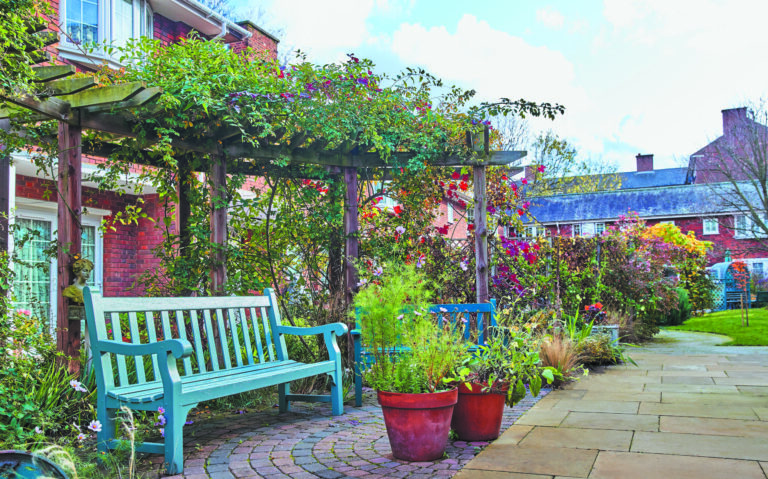
Community is a central part of almshouse life. Homes are often arranged around shared courtyards and gardens, with communal spaces designed to encourage neighbourly support and interaction. Many almshouses are located at the heart of the wider community, helping residents stay connected to familiar services, activities and opportunities. Staff are often on hand to provide practical support and facilitate activities that help residents build friendships and maintain meaningful social connections.

This sense of community is particularly important at a time when loneliness and social isolation are increasingly recognised as major challenges for older people. By creating environments where people can get to know their neighbours, participate in activities and feel part of something larger than themselves, almshouses help foster belonging and connection.

Many almshouse charities also contribute to the wider community. Hammersmith United Charities, for example, provides funding to local organisations that help strengthen community ties, reduce isolation and improve wellbeing across Hammersmith.

In short, almshouses do more than provide affordable housing. They help create communities where people feel connected, supported and valued, making an important contribution to tackling loneliness and building stronger neighbourhoods.

Apply for a home

We currently have flats available at both of our almshouses – John Betts House and Sycamore House. We’re always happy to show prospective residents around. Find out if living here could be right for you.


Support if you’re feeling lonely

Help is available if you’re struggling with loneliness or isolation. For example, befriending services can be a great way to meet new people and feel more connected. H&F council has provided a list of local befriending services here. You might also find this list of national organisations useful.

Read More ...
A man and a woman smiling at the camera. She is wearing a Nourish Hub T-shirt so is likely a volunteer

Nourish Hub

Reducing food waste while bringing people together

Coming together to ‘break bread’ and share a meal is an important part of many cultures. However, when friends and family live far away, communal meals can feel like a distant memory, especially when money is tight.

Nourish Hub is helping to change that, and reducing food waste in the process. Its community lunch runs five days a week. People are invited to sit down together and enjoy a freshly cooked, nutritious three-course lunch for a suggested donation of just £3 per person. In the last financial year, the charity served 33,921 meals, with the help of around 200 volunteers. Every lunch is made from ingredients that would otherwise be wasted, from wonky carrots to surplus bread.

Hub Manager Andreea Rizea says, “It’s not just about food, it’s about community building. This is a safe, inclusive and welcoming space, where people can make connections with other members of the community. There are good vibes, good people and a spirit of togetherness.”

Some of the people who come to the community lunch are otherwise quite isolated. One regular attendee shares, “Nourish Hub gets me up and gets me out of the flat. I’m able to socialise with a lot of people.”

A group of Nourish Hub volunteers and staff members in the kitchen

Tackling waste

Nourish Hub’s parent charity, UKHarvest, collects surplus food from distributors, farmers, supermarkets and hotels. The community hub also receives food from other partners, such as City Harvest and Chiswick House & Gardens, and it grows leafy greens and herbs in its own indoor growing towers.

When you consider that almost a third of greenhouse gas emissions are linked to food production and that almost 2 million tonnes of food is wasted in London every year, it’s clear that charities like Nourish Hub benefit the environment as well as people.

The Hub often receives lots of one particular type of food, whether that’s butternut squash or cabbage, so the team needs to come up with creative ways of using it. Andreea says, “Every morning is like Ready, Steady, Cook in our kitchen! There’s a lot of creativity and we’ve got a very diverse team of volunteers who all share their own recipes, so our menu changes daily.”

A man and a woman smiling at the camera. She is wearing a Nourish Hub T-shirt so is likely a volunteer

The average home wastes around £470 of food every year. There are many reasons for this, including confusion around food labels and a lack of meal planning. Andreea says, “This is an issue that we take very strongly, so alongside our community lunch, we have a very comprehensive education programme – NOURISHed. It’s delivered by our in-house nutritionist Helen and our education & events chef Tom. We teach everything from simple cutting skills to more complex recipes, and alongside that, we teach people about nutrition, budgeting and how to reduce food waste, for instance by freezing bread and milk if they’ve bought too much and making stock with vegetable peel. Last year, we delivered 265 education sessions and events through NOURISHed”

Clothing waste is another major environmental issue, so Nourish Hub has partnered with Regarm – a community clothing initiative – to redistribute pre-loved clothing for free. Each week, people can choose items of clothing that have been collected from Notting Hill Market and other areas.

The charity also runs clubs and workshops to bring people together and reduce waste. These include a sewing and clothes repair course run by La Modista, and a shared reading group.

Community pantry

This year, Nourish Hub has launched a new service – a community pantry where people make a £5 donation to fill a bag with surplus produce of their choice. Andreea says, “As well as addressing food insecurity, it’s about long-term wellbeing and dignity. There’s no eligibility criteria and we try to offer wraparound support through organisations like Citizens Advice, Shelter and Turning Point.”

Volunteer

Nourish Hub relies on a large team of volunteers, many of whom have received support from the charity themselves. Some are there to share their skills, others to gain new skills and work experience. All want to share their love of good food and give something back to their community. As one volunteer, Niall, says, “Before I came here, I was struggling with mental health problems and unemployment. This seemed like a safe environment for me to develop social skills and do what I love doing, which is cooking.”

Join in

Nourish Hub is open to everyone, whether you want to attend a free cookery class, join a book club, or take part in a community lunch. The charity is also keen to hear from people who are interested in volunteering to cook or serve meals. Find out more at www.nourishhub.org.uk or watch the video below:


Read More ...
Graphic says 13 groups have been awarded grants totalling £107,500.

February 2026 grants announced

13 groups have been awarded grants totalling £107,500.

Thousands of people in Hammersmith rely on the voluntary sector. From toddler groups to emergency food parcels, the services offered across the borough change lives.

We’ve been supporting these grassroots causes for many years, by awarding Community Grants to groups that make a tangible impact, including those working to alleviate poverty, enrich children’s lives, and help some of the most vulnerable people in Hammersmith.

Our February grants round saw 13 groups awarded a total of £107,500. These include:


Bubble & Squeak: £15,000

Bubble & Squeak takes nutritious, quality food that would otherwise be wasted, and gives it to people in Old Oak who are struggling to afford basic essentials. Recognising that working people can’t always access morning and afternoon sessions, the CIC is using its grant to open a food stall two evenings a week. Find out more about Bubble & Squeak.

1000 Black Boys: £15,000

1000 Black Boys’s grant will be spent on mentorships and activities to inspire and empower 300 Black boys, girls, young men and women. Read our case study on 1000 Black Boys.

Wendell Park Primary School: £12,900

Six Wendell Park pupils will benefit from specialist art therapy, helping them to work through trauma and other challenges. Their parents will also be supported to better understand and respond to their children’s emotional needs. Read about art therapy at Wendell Park Primary School.

The School & Family Works: £12,000

The grant will pay for a trained therapist to support eight families at Old Oak Primary School. The families will come together once a week to take part in activities, share ideas and learn from one another.

The Kulan Foundation: £10,000

Our funding is supporting the Kulan Foundation’s free homework clubs for 80 children and teenagers. It will also contribute to the cost of delivering parenting workshops and helping elderly residents. Most of the charity’s beneficiaries are from a refugee or migrant background. Read about the Kulan Foundation.

The Creighton Centre: £8,000

170 people who are living with dementia will be matched with volunteers, who will help them to stay safe and connected to their community and to access additional support where needed. Find out more about the Creighton Centre.

Hammersmith & Fulham Foodbank: £6,500

Hammersmith & Fulham Foodbank supports thousands of people in crisis every year. The charity is using its grant to provide emergency food through its Shepherd’s Bush, Old Oak and White City centres. Read about the foodbank’s work.

Lyric Hammersmith Theatre: £5,850

300 people on a low income will be able to watch a play at the Lyric and 90 young people will be able to take part in a theatre programme, with the help of our funding.

BlindAid: £5,000

BlindAid will use its grant to support 100 blind and partially sighted adults, including through home visits and regular phone calls.

Hammersmith Academy: £5,000

Many of the children at Hammersmith Academy don’t have their own garden, so the one at their school is crucial for their wellbeing. The grant will help to cover the cost of a specialist gardener. Read about how the garden has inspired a new generation of nature lovers. 

Lawyers4Learners: £5,000

330 Year 6 pupils will take part in free public speaking workshops, so that they can feel more confident in communicating their ideas and start building skills they’ll use throughout their lives.

Grove Neighbourhood Centre Folk Art Group: £2,250

The grant will fund weekly art sessions at the Grove Neighbourhood Centre. Read about the impact that the art sessions have on people’s lives, including reducing loneliness and increasing creative expression.


How to apply for a HUC Community Grant

We’re keen to hear from smaller, local organisations in our area of benefit, which have a strong connection to their community and a working knowledge of the local area. Your project can be one-off or ongoing. What interests us most is the difference you’ll make to the local people most in need.

Please complete our Eligibility Quiz before applying and then contact us at grants@hamunitedcharities.com to tell us about your project. We like to talk to applicants before you apply to get a better understanding of what you’re doing and answer any questions you may have.

Find out more

Read more about how to apply

Read More ...
Paul at the top of a mountain wearing a hat, sunglasses and a raincoat.

Age Without Limits

“I prefer the phrase ‘renaissance’ to ‘retirement’”

Ageism can be incredibly damaging. It limits older people through assumptions, not because of their actual ability. It affects how they’re treated in everyday interactions, education and the workplace, and it makes people feel devalued.

June 10th is Age Without Limits Day. The campaign by the Centre for Ageing Better aims to “create a society where everyone enjoys later life free from the impact of ageism.”

It’s a vision that’s very close to our hearts, as all our residents are over 60. Several of them are still in paid employment and many are still very active in the community in other ways, including through volunteering. As one of our residents, Siobhan, says, “Volunteering is a way of giving something back and helping others. It gives one a good feeling.”

Paul at the top of a mountain wearing a hat, sunglasses and a raincoat. Several of our team members are also over 60, including our Head of Grants and Community, Paul Robson, who joined us aged 65. He says, “I was working for Age UK, but I wanted to move to a smaller organisation with more of a local focus, where I could see the impact first hand.”

Changing jobs can be challenging at any age, but even more so when you’re approaching retirement. One in three people aged over 50 believes they’ve been turned down for a job because of their age, and the situation is likely to be even more difficult for those over 60.

As Carl Honoré wrote for Age Without Limits, “Older employees are routinely passed over for promotion, discarded first in hard times, denied training or given unfulfilling work.”

Paul says, “I did think, ‘They’re going to see from my CV how old I am, realise that I’m approaching state pension age and worry about how long I’m going to stay.’”

While ageism is a barrier at many organisations, we value experience. Paul has now been working at Hammersmith United Charities, part-time, for over three years. He’s considering stopping paid work next year when he turns 69. However, as he explains, “I prefer the phrase ‘renaissance’ to ‘retirement’. There’s this myth that as you get older, there’s an inevitable decline, and that when you stop paid work, it’s downhill, physically and mentally, from there. Losing the routine and structure of paid work does scare me a little, as does losing the sense of identity you get from paid work, but actually, this time can be really exciting.

“We all do a mixture of things throughout our lives – a bit of paid work, a bit of learning, a bit of caring for others, a bit of leisure time, maybe a bit of community work. How you balance that and use your time, effort, mental energy and physical energy, is in flux throughout your life; the size of each slice of the pie changes. There was a time when the caring slice of my pie was quite large, but now that’s smaller and I’ve slowly been reducing paid work while increasing my community work.”

Paul currently volunteers with Age UK Richmond and with Cocoon – a charity for young people leaving care. He wants to take up more volunteering opportunities once he’s finished paid work. Alongside volunteering, Paul is planning to make the most of his free time by staying physically and mentally active. Amongst other things, he wants to delve into philosophy and learn tai chi. As he says, “‘Lifelong learning’ might be a bit of a cliché, but it really is so important.”

One of Paul’s favourite pastimes is hiking in Scotland and the Lake District, particularly hill and mountain walking. “The Munros in Scotland are peaks above 3,000 feet. I’ve done around 68 of them. Some people try to climb all 282. A few years ago, a 79-year-old guy decided to do them all, and he did it in two years. I don’t think I’ll attempt that, but I do enjoy the experience of being outdoors and the physical and mental challenge of six-to-eight-hour walks, up three or four thousand feet, over 16 or so kilometres.

“I’m in a fairly privileged position in terms of health. I’ve invested in that by keeping active and through lifestyle changes, including drinking less and improving my diet.

“It’s all about investing in myself for the future.”

Read More ...
View More