Facebook Twitter Instagram

“I’ve got everything to live for”

Meet Bill, one of our sheltered housing residents.
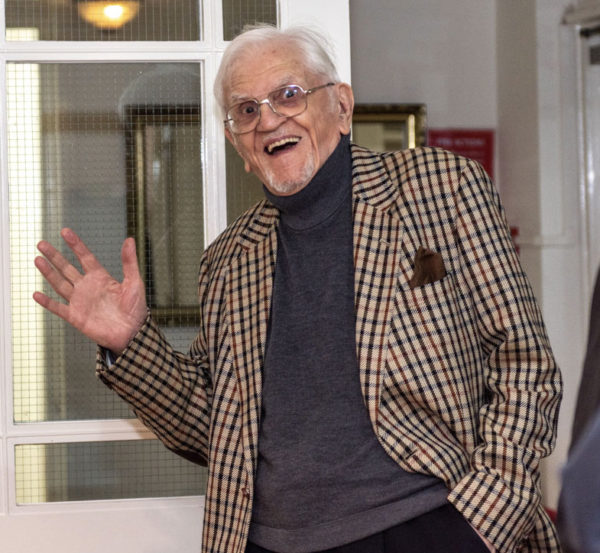
Bill

He’s had a singalong in an air-raid shelter, played a giant gorilla on the big screen and been around the world eight times. Now one of our residents Bill is happily settled in a quiet Hammersmith haven with everything he needs (plus a few new grandchildren to keep him busy).

I used to live in a bedsit just around the corner from here in Rylett Avenue. I’d walk past John Betts House every day and think, “That looks like a nice place to live.” I never dreamed I’d live here myself.

I happened to meet a lady who lived at John Betts in my art class, and she told me there were units available. And that was it. I can’t believe I’m living in such a comfortable place in my old age. This is the centre of London, but it’s so peaceful. You can hardly hear a sound.

Where I began

I can remember when London went through the Blitz. I was living in Scotland at the time. We never saw a single plane, but if an air-raid siren went off in London, a siren would go off in Brechin as well. If the Londoners were hurrying into their shelters, then off we’d go too – quick march. We’d have a good singalong, and even lessons if a teacher was in the shelter. And you’d be in trouble if you were caught without your gas mask. It’s a bit like today. Now, I think: if we all pull together like we did back then, we’ll win this war too.

I got my first taste of cinema in those days. Every Saturday afternoon we went, and it was always packed solid. Two pennies to get in. I loved ‘cowboys and indians’ sorts of films like the Lone Ranger. Since then, acting has been my life. I’ve been in about 100 films. I started at 15, and one of my first roles was playing one of Fagin’s boys in Oliver Twist. Eventually I made a bit of a name for myself as an arch-villain, I think because I was tall, had black wavy hair and a deep voice. I played Dracula and Frankenstein’s monster on stage. It was fun; everyone likes to be scared, from a safe distance.

My most famous role was Konga, a 1961 sci-fi horror film directed by Herman Cohen. It was about a giant gorilla which ran riot and I had to wear an ape suit for six hours a day, 10 days straight. I did most of the scenes on my own against a blue screen, chasing people, bending over houses, causing mayhem. Jess Conrad was one of the stars of the film. He was terribly good-looking and all the girls were mad about him. I had to kill him, which didn’t make me very popular.

Film-makers find it pretty hard to get 80-year-old actors, so I was still doing about a day a month on films up until last year. The last one I did was Stan and Ollie. But I’ll be 90 soon and I’ve had enough now. I’m quite happy just watching.

There were a few breaks from acting: I was called up for national service and sent to Egypt around the time of Suez Canal troubles. I worked in the Forces broadcasting service. I quite enjoyed it, but all that sunshine and sand! It was like being on a beach for a year. There wasn’t much to do.

I was also an entertainment officer on P&O cruise liners and I travelled around the world eight times. I organised cabarets and dances – and yes, of course I got involved too! I saw Rio, Sydney, New York… But do you know the place that I found most exciting to sail into? Southampton. Coming back home.

A peaceful haven

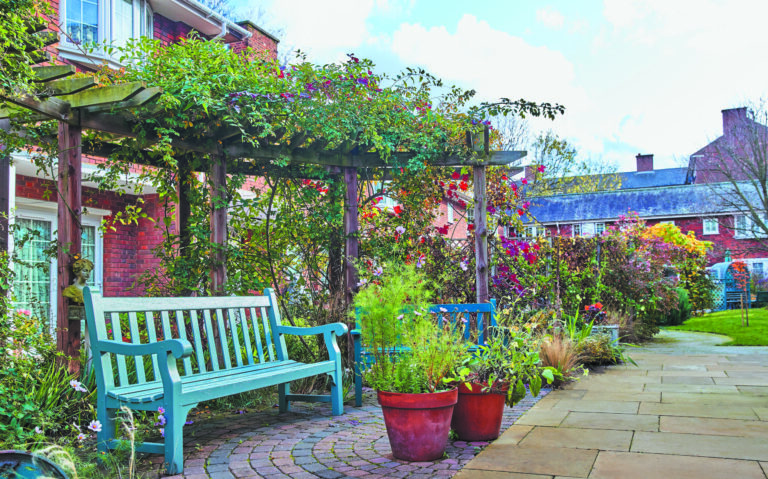
I never imagined that I’d finish up in such a lovely place. John Betts House has got everything you could want. When I wake up in the morning, the sun comes streaming in through the big windows. There are huge gardens right outside, and you can smell the flowers in my room.

I always say that when you get past 60, you develop a personality – everyone here is really interesting. People are friendly and happy to chat if you want, but they also mind their own business. There are always things to do, if you want to: social activities, coffee mornings, quizzes. I’ve been on trips to Bath and Winchester, and up the canal on a boat. I’ve also taken up painting in the last 10 years and that has kept my artistic juices flowing.

Things are a bit different at the moment. But this feels like one of the safest places in London. We are in an enclosed community, so there is no need to go out if you don’t want to. Occasionally I get up very early and go for short walk, when nobody’s around.

I’ve got three children but up until a few years ago there were no grandchildren. Now I’ve got two, with another one on the way. It’s like waiting for the number 7 bus. But it’s absolutely thrilling – I’ve got everything to live for.


Find out more about our sheltered housing

We provide beautiful and affordable sheltered housing in our almshouses, with award-winning communal gardens.

Call Leslie, our Housing Manager to find out more or to come and visit: 07470 793 565, email leslie.morson@hamunitedcharities.com or go to have a look at our sheltered housing pages.

Flats are now available in our almshouses

If you think you might be eligible, we'd be happy to give you a tour of our almshouses and share what it's like to live here.

Read More ...
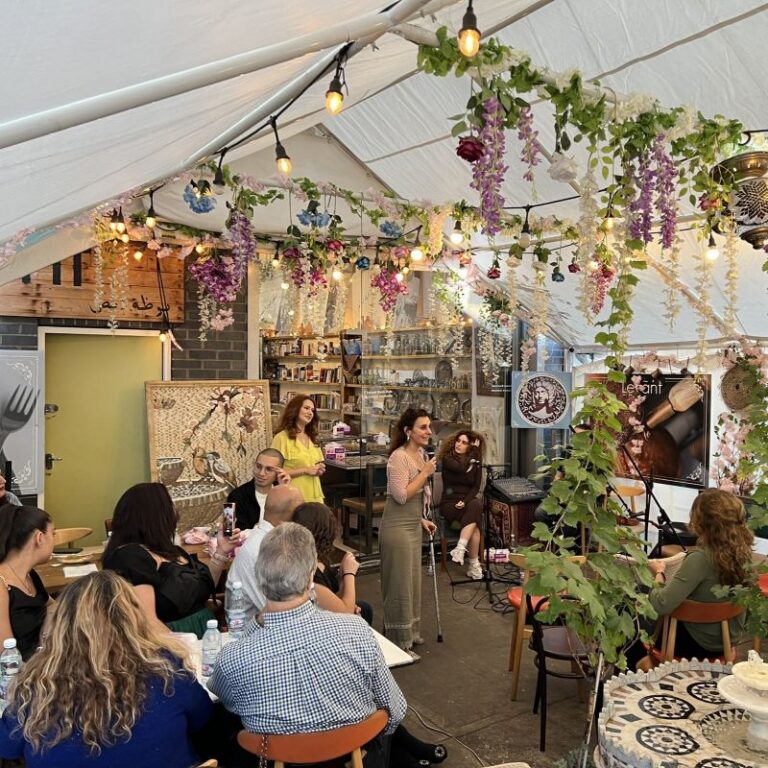
A woman is giving a talk to an audience. They are in a marquee.

Hikayetna

Making it easier for Arabic-speaking people to access mental health support.

The benefits of open conversations around mental health are now widely understood, but language and cultural barriers can make it more difficult for some people to talk about their feelings and to seek help when they need it.

According to the Mental Health Foundation, “Asylum seekers and refugees are more likely to experience poor mental health than the local population, including higher rates of depression, PTSD and other anxiety disorders.” However, people newly arrived in the UK, who may not be fluent in English, often don’t know what mental health support is available or how to access it.

Bringing people together through storytelling

Hikayetna is a not-for-profit organisation that brings people together through storytelling and creativity. As Project Manager Sulaiman Othman shares, “Our main purpose is to bring the community together. We’re open to everyone – migrants and the local community. Our activities are around storytelling – how to tell your story through music, photos, film, poetry or writing.”

Projects include a print newspaper, Grapho, which, as Sulaiman explains, “gives refugee and migrant young people a voice and the encouragement to write. It gives them skills and a sense that they’re part of the community, a part of society.”

Sulaiman recognised that many of the people Hikayetna works with find it difficult to talk or write about mental health. He shares, “There’s a need to reduce the stigma around mental health, particularly within the Arabic-speaking community, because we don’t usually talk about these issues. We keep our feelings, our problems inside.”

He approached Hammersmith United Charities about a grant to help raise awareness of mental health support amongst West London’s Arabic community. Hikayetna used the funding to create three short videos and a leaflet. The videos are in Arabic, with English subtitles, and aim to bridge cultural and linguistic barriers. They cover what mental health challenges can look like, why it’s important to get support and how to access that support. Two feature Arabic-speaking mental health specialists working in the NHS. The third is an animation based on one refugee’s experiences of mental ill health.

Please feel free to share the films with anyone you feel may benefit.

[Content warning: The following video follows the journey of someone who considered ending their life.]

The videos will be screened at a Hammersmith United Charities event later this month, alongside other films showcasing the work of our grant holders.

Support Hikayetna

Hikayetna is always keen to hear from people who want to volunteer to help with workshops, outreach events and other activities. It’s also seeking additional funding to run more storytelling projects for the West London community.

Read More ...
Graphic saying Supporting International Women's Day

International Women’s Day

While there is still much work to do, there is also much to celebrate.

March 8th marks the 115th anniversary of International Women’s Day. In many countries across the globe, from Afghanistan to the US, women’s rights are under attack. Even here in the UK, women remain at a significant disadvantage compared to their male peers. While the gender pay gap is narrowing, it is far from closed; London has the second largest pay gap in the country, 10.7%, considerably worse than the UK average of 6.9%.

Gender-based violence also continues to affect millions of women and girls across the UK. One in four women will experience domestic abuse in their lifetime; women are twice as likely to be harassed than men, and a woman is killed by an abusive partner or ex every five days in England and Wales. 907 sexual offences were reported across Transport for London (TfL) services between January and June 2025 alone.

Organisations supporting women in Hammersmith

Although the fight for gender equity is far from over, there is still much to celebrate on International Women’s Day, including the charities, CICs and community groups who make a considerable difference to the lives of women and girls across Hammersmith. Many of these organisations are current or previous Hammersmith United Charities grant holders.

This year’s theme for International Women’s Day is Give to Gain. The global movement is encouraging people to donate to a women-focused charity, such as those listed below, as a way of taking action on women’s rights.


FORWARD

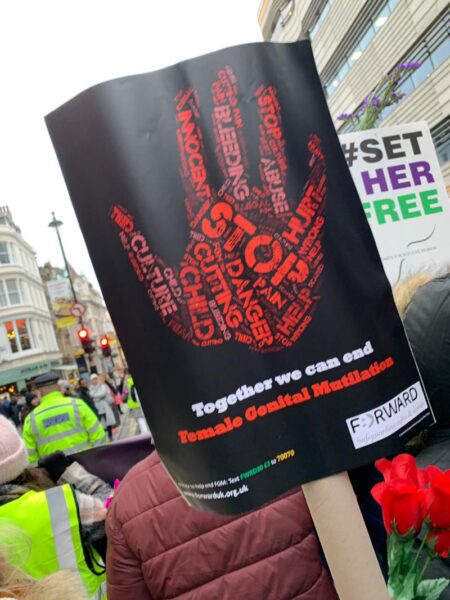
Image shows a placard with a graphic of a hand. The hand is made up of words, including 'stop'.


FORWARD is a London-based charity working to tackle multiple forms of violence directed against women and girls in Africa and the UK. Its focus is on faith-based and ritual abuse. The Executive Director of FORWARD, Naana Otoo-Oyortey MBE, explains, “We’re looking at women who are affected by female genital mutilation, by child marriage and by domestic abuse. Some of the women have been trafficked; some are refugees or asylum seekers.”

As well as supporting survivors, FORWARD is helping women to break the cycle of faith-based abuse.

Read our case study on FORWARD.

Woman’s Trust

Woman’s Trust provides free mental health care to women who have experienced domestic abuse. One of the charity’s clients wrote, “My experience getting help and support from Woman’s Trust was invaluable. I was not in a good place and didn’t know that I was in an abusive relationship for all those years and what was abusive about it. When it’s psychological abuse, it’s very difficult to decipher. WT helped me to see things and to understand what was happening to me, which made me understand why I have been feeling so depressed for so many years.”

Read our case study on Woman’s Trust

The RENA Initiative

Image shows 20 colourful painted self-portraits

The RENA Initiative brings women together to enjoy creative activities, make friends, experience new activities and reduce stress and isolation. Attendees are mainly older women from marginalised communities. As one participant shares, “The project has done excellent work to educate me, improve my self-esteem, expose my hidden talent, keep me in touch with the community, gain new friendships and have a better quality of life.”

Read our case study on The RENA Initiative

Women Aid and Empowerment

Women Aid and Empowerment offers free Zumba, chair-based yoga and chair-based exercise classes in Hammersmith. Co-founder Hanna Teffera shares, “I have a lot of retired and widowed people attending. Many used to be active but had become ill or disabled. Some had become isolated in their home. Since coming to the class, their health has improved and so has their loneliness, as they feel that they have somewhere to go. They talk after class, meet up with each other and feel more connected with their community.”

Read our case study on Women Aid and Empowerment

The WILDE Foundation

The WILDE Foundation empowers women to write about traumatic experiences such as abuse, and to share their stories in a safe, supportive environment. By doing so, the women can be helped to process and heal from their trauma, improve their mental health and regain a sense of control over their lives.

Read our case study on The WILDE Foundation


Find out more

Learn about the history behind International Women’s Day and this year’s Give to Gain theme at www.internationalwomensday.com

Read More ...

Family Friends

Helping parents and young people to connect with their community

Two young women and one young man

Most of us need someone to turn to at times – someone who will listen without judgement and offer advice and support. However, not everyone has that safety net. It’s all too easy to feel isolated from your peers if you’re new to the area, English isn’t your first language or you’re shy, for example.

Family Friends supports families in a number of ways, including through a games group for young people, a coffee and community group for parents, a walk and talk group for families, and a monthly SEN group. However, at the heart of the service is its befriending scheme.

Volunteers are matched with adults or young people who are struggling and need someone to talk to. As Shona Goolab from Family Friends says, “There’s nothing better than just having someone to talk to. It’s kind of like a comfort blanket, knowing that someone will consistently show up for you and help you get back on your feet.”

For parents, this might mean having another adult to talk to about money troubles or other difficulties, or someone to offer encouragement when you’re feeling overwhelmed. Kabira lives with her blind husband and three young children in a one-bedroom flat. When she was referred to Family Friends, she was struggling to meet people and wasn’t confident speaking English.

Kabira’s volunteer befriender has helped her to discover more of the opportunities available in her local area. She helped Kabira to join the local library, enrol for English lessons and take part in a singing group. They’ve been to local shops and cafes together, and Kabira has become more confident in practising her English.

Family Friends also matches volunteer ‘big buddies’ with children and young people. One such young person is 13-year-old Sara. Bullying, including physical assault, had left Sara feeling anxious and depressed. With her big buddy’s help, Sara’s confidence has increased and she’s found tools to better manage her anxiety.

Where possible, the charity matches young people with volunteers who share their interests. Shona says, “One of the young people we work with is really into music. Our volunteer has connections within the music industry so took him to a music studio. We’ve also taken him to Kew Gardens, Winter Wonderland and other places, and he’s made friends with other young people in our group. It’s been lovely to see him come out of his shell a bit; his mom says that he’s a lot more confident in school now.”

The relationship with the volunteer usually lasts six to 12 months, during which time the volunteer and Family Friends will help the family to make new connections and build their own support system. As Shona explains, “It’s about helping them to engage with their community and build their confidence so that they don’t need us anymore.”

Hammersmith United Charities’ grant

Family Friends is one of our Flexible 3 Year Grant holders, so is receiving £15,000 a year from us for three years. Having the funding agreed in advance has enabled the charity to make plans, including organising seven two-day workshops a year to train volunteers.


Befriend a local family in Hammersmith

If you have two hours a week to spare, you could make a real difference to a family’s life. You’ll receive full training, ongoing support and expenses. Find out more at www.familyfriendscharity.co.uk.

Read More ...
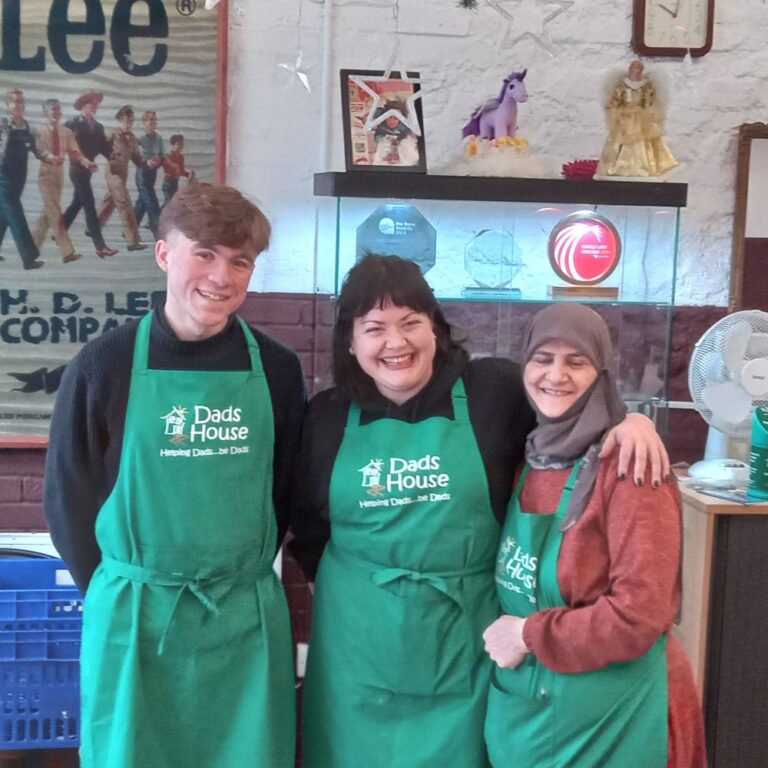
One man and two women wearing Dad's House aprons. They are all smiling and have their arms around each other.

Dad’s House

“Where there was once trauma, fear and uncertainty, we now have peace, stability, and the chance to heal.”

Back in 2008, Billy McGranaghan founded Dad’s House as a food bank for single fathers who were struggling to make ends meet. However, the charity’s remit soon expanded.  Billy explains, “I set up the food bank and not one dad turned up! So, it became a community food bank overnight.”

Today, the charity aims to support people’s emotional needs as well as their financial ones, and now offers everything from a food bank, family law clinic and dads’ support group, to guitar lessons and yoga classes.

Billy was recently awarded an MBE in The King’s New Year Honours List 2026, for his work at Dad’s House. Together with a small team of paid staff and a large team of volunteers, he’s helped some 80,000 families.

One man and two women wearing Dad's House aprons. They are all smiling and have their arms around each other.Food bank and lunch club

Every week, around 160 families rely on the food they receive from Dad’s House. As Billy says, “Everybody’s broke. The cost of living is killing everybody. Food inflation is up another 3% and it’s not going to come down.”

Alongside the food bank, Dad’s House runs a weekly lunch club, where people can come together to eat nutritious food and socialise with others who understand what they’re going through. One client shared, “On Tuesdays with Dad’s House’s weekly lunch clubs, I can leave my house and know I have somewhere to talk with other people and feel part of a community.” The club is particularly needed during the school holidays, as without free school dinners children may not always have enough to eat.

Dad’s Table

A key aim of the charity is to combat loneliness and isolation. It’s often difficult for single dads to maintain friendships and meet new people. Not many jobs allow you to work in school hours only, but lower wages don’t cover childcare costs. As a result, many of the fathers the charity supports are unable to work. They’re often isolated at home for much of their spare time, as they can’t afford to meet friends for a drink, play organised sports or invite people over for lunch.

Alongside that, as Billy explains, “A lot of the dads are going through family breakdowns; it’s probably the most difficult time in that dad’s life, and the family court system is a black hole that can last up to two years.”

Dad’s Table gives struggling dads a supportive environment to talk about the difficulties they’re facing. The mutual support group meets twice a week. As one member explains, “Dad’s Table gave me a space to express my anger, my frustration, and my sadness. But it also helped me realise that I wasn’t powerless. I started to see that there were ways I could move forward, both for myself and my children.”

Family law clinic

A pro bono family law clinic is held twice a week to support people with disputes around child arrangements. Most of the clients are either being denied contact with their children or want to put measures in place to protect them. The service receives 5,200 telephone calls and 2,500 emails per year and has directly supported more than 800 clients through the family law court.

Billy says, “Our legal director is a solicitor called Simon Bruce – one of the top financial solicitors in the country. We have a family law clinic manager, and around 10 solicitors and 50 barristers who volunteer with us. Last year, we provided £1.3 million worth of pro bono work, and that’s due to the team that we have of people who care.”

One recent client shares, “I truly appreciated Dad’s House’s unwavering focus on the children’s wellbeing. They ensured that they remained at the heart of every legal decision. Today, midway through 2025, my children and I are finally free from the court process. Where there was once trauma, fear, and uncertainty, we now have peace, stability, and the chance to heal. Looking back, I cannot overstate the impact of their work – not only in securing the right legal outcomes but also in restoring my belief in justice.”

Hammersmith United Charities’ grant

Last year, we awarded Dad’s House £7,300 to help with energy costs and to provide essential supplies for families.

Dad’s House relies on grants and donations to run the charity. Billy shares, “A lot of our funders live locally, so they’ll pop in for a cup of tea or some lunch and see what we do on a daily basis. I’m also constantly on the phone and in meetings all over London raising money.”

Support Dad’s House

Most of Dad’s House’s team are volunteers. Without volunteers, there would be no food bank, law clinic, lunch club or any of the many other services that the community rely on. If you can spare a few hours to support struggling families, visit www.dadshouse.org.uk to find out more or email info@dadshouse.org.uk.


Read More ...
View More