Facebook Twitter Instagram

The Violence Intervention Project

“The way they want to be seen is driven by the need to protect themselves, to keep themselves safe.”

The Violence Intervention Project (the V.I.P) works with children and young people, aged 12 to 26, who have entered the youth criminal justice system because of their violent behaviour.

Most of the charity’s clients are boys and young men who have experienced adverse childhood experiences. Head of Therapeutic Operations, Ashley McMahon, shares, “These are vulnerable young people, but no one thinks they’re vulnerable; most people think they’re monsters. No one thinks about the abuse, the trauma, the vulnerability.

“These young people have usually experienced violence within the home setting, generally perpetrated against their mothers and themselves by males. There’s a prevalence of mental health issues within the families and often undiagnosed neurodevelopmental issues. There’s also poverty; one boy we saw recently hadn’t eaten for three days.

“They’re stepping out with all these vulnerabilities, and no idea of what safety looks like. When your home environment is really unsafe, violence becomes normalised and everybody is a threat. If you don’t believe that someone will come and help you in a dangerous situation, then picking up a knife or a gun to keep yourself safe seems a logical response. One boy told me that the reason he’s so violent is because he wants to protect his friends the way he wishes he’d been protected. Some of the men he’s attacked are three times his size.”
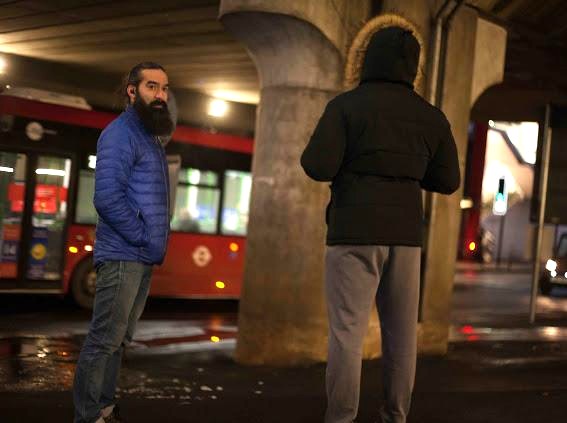
A man and teenage boy talking in the street. The boy has his hood us and back to the camera. “The relationship is the intervention.”

As Ashley says, “How do you become a man when the only men in your life have been monstrous and dangerous?

“Our intervention, which we call urban therapy, is around therapeutically trained practitioners building relationships with young people, to offer them a relational experience of somebody who is attentive, predictable, consistent and caring. The relationship is the intervention.

“We meet the young people out in the community, in spaces where they feel comfortable, rather than expecting them to come to a traditional clinic setting. The aim is to build long-term relationships so that we can support these vulnerable adolescents through the process of growth and development into adulthood. It’s a privilege to be invited into their lives, because they do everything they can to keep people away.”

The V.I.P also works with the people who have a direct impact on these young people’s lives, such as teachers and families. Supporting mothers is often a crucial part of the process, as they’ve often experienced domestic abuse and may be struggling with substance abuse, all of which has become normalised for the young person. By helping to change the eco-system that surrounds the young person, the charity can make a greater impact on their life.

A teenager with his back to the camera, looking out over the Thames at the city lights

The way they want to be seen is driven by the need to protect themselves.”

The V.I.P recognises that the violence shown by young people is usually related to a sense of shame. The abuse and trauma they’ve experienced has resulted in severely low self-esteem. If the people who were supposed to care for and protect them didn’t, what does that say about them?

Ashley explains, “Shame is a massive part of what drives our young people’s behaviour – this idea of feeling exposed and doing everything they can to prevent people from seeing their vulnerability. They want to be seen as powerful and in control – somebody that you wouldn’t want to cross.

We help them to recognise that the way they want to be seen is driven by the need to protect themselves, to keep themselves safe, to feel in control and to feel that they have agency in the world.

“As human beings, we’re so dependent on relationships in order to function and to thrive. This ‘protective armour’ that our young people wear stops them from connecting to others. We help them to put down that armour.”

“A lot of these young people can’t imagine a future.”

Ashley shares, “What trauma does to the human brain and the nervous system, is it prevents you from moving forward. A lot of these young people can’t imagine a future because they don’t feel safe enough and don’t believe that they have control over their lives.”

The V.I.P aims to give young people a purpose and show them that a better future is possible. In many cases, this means helping them to get back into school or on a training course and arranging work experience.

Most of the charity’s clients are living in poverty, so enabling them to make money, legally, is crucial. Another key benefit of education and employment is that the young people’s social networks are extended, helping to reduce their isolation and their reliance on gangs.

V.I.P Voice

The V.I.P is one of our Flexible 3 Year Grant holders, receiving £45,000, split over three years. The charity has used some of the money to set up V.I.P Voice – a small committee of former service users. Ashley explains, “These are people in their 20s who have been on a journey with us for several years. They’ve been able to work through their traumas, work through their shame, build positive relationships and secure employment and training. They’re now supporting us by informing what our intervention should look like.”

Ashley found it particularly helpful to have the funding agreed upfront for three years: “Small-to-medium-sized charities are walking a tightrope every year. We’re living in such a financially precarious environment; there have been some real nail-biting moments. Having a grant funder that’s committed to three years is game changing. It offers us structure and stability, which enables us to offer this to our beneficiaries.”

Impact

The V.I.P has worked with more than 200 young people to date, most of whom have seen tangible benefits over the years, such as improved mental health, increased engagement in education and training, and reduced violence. The biggest impact is often around trust and a feeling of safety, both of which are very difficult to quantify. As Ashley says, “How do you measure the impact of a young person feeling safe enough to be able to talk about the most horrifying thing that’s ever happened to them? What does it mean to a young person to be believed?”

“My colleague sent me a text message the other day from a young person saying, ‘I love you.’ This is a boy who’s experienced so much violence, who’s been physically abused by his father, witnessed his mum being torn to pieces and learnt that men are violent and threatening.

“Through three and a half years of consistent work, they’ve built enough safety in their relationship that this young lad now understands, not just that other people can be safe and kind, but that he can be safe and kind too.”


Support the V.I.P

You can donate to support vulnerable young people here.

The charity also offers training in shame-informed practice for organisations that work with young people. The Shame Initiative includes:

  • Training for frontline professionals and organisations
  • Tools to embed shame-informed principles in everyday practice
  • Consultancy with leaders and systems
  • Collaboration with academics, funders and policymakers

Email contact@vip.org.uk to find out more or download the brochure here.

Flats are now available in our almshouses

If you think you might be eligible, we'd be happy to give you a tour of our almshouses and share what it's like to live here.

Read More ...
A group of smiling children at the Sulgrave club

Celebrating Hammersmith’s communities through film

We commissioned Media Trust and Constellation Films to create short videos highlighting the work of four of our grant holders.

Life is difficult for many people in Hammersmith right now. It’s a challenge to afford the bare essentials. ‘Nice-to-haves’ are out of reach, even when they could make life easier in the long run. Charities are facing a similar issue. When core costs are high and teams are stretched, there’s little to no money available for marketing or communications.

At Hammersmith United Charities, we aim to do more than fund good work – we champion community organisations and raise awareness of the issues they’re tackling. With this in mind, we commissioned Media Trust and Constellation Films to create short videos highlighting the work of four of our grant holders: Sulgrave Youth Club, This New Ground, Barons Court Project and Nourish Hub.

You can watch the videos below.

We also funded Hikayetna to produce Arabic-language mental health videos, responding directly to local insight about the barriers faced by our Arabic-speaking communities when it comes to seeking mental health support.

The five organisations each came with their own priorities – reaching new beneficiaries, raising funds, attracting volunteers, changing attitudes – but collectively, these films go even further. They help to build a richer, more visible picture of the strength and diversity of Hammersmith. It’s a community we can, and should, be proud of, and one that deserves our support.


You can watch Hikayetna’s films here.

Film screening

On 17 March 2026, we gathered at Riverside Studios for a community screening to showcase the films, celebrate the work of the filmmakers, and bring local people together to spark new connections and open the door to future collaboration across Hammersmith.


People gathering around the food table at the film screening

One of the films being shown in the cinema

Hetty and Paige checking names against the register

If you would like to stay up to date with future events, please scroll to the bottom of the page to sign up to our newsletter.

Read More ...
Ken, a man in his 60s, standing by a trug full of plants and surrounded by pots of plants

Happy National Gardening Week!

Why our communal gardens are integral to almshouse life

The theme for this year’s National Gardening Week is ‘Share your passion for plants’. Whether you’re an avid gardener or just enjoy relaxing on a bench surrounded by colour and birdsong, most people enjoy being outside in spring. As our Community Gardener, Victoria Cripps (known as V), says, “As a Community Gardener, it is very important to me to advocate for gardening as a means of supporting wellbeing. I know, through my own daily experience, that being in nature and caring for plants and wildlife has a positive effect on my mental and physical health. Gardening is both physical exercise and a mindful, focused, creative activity.

“The residents here comment daily on the effect the garden has on their wellbeing – from particular plants evoking positive memories, to hearing birdsong and feeling joy, seeing colour and feeling uplifted, and experiencing the pride of new seedlings emerging! Those who actively garden also comment on how it supports them to stay active, as well as the enjoyment of focusing on a project and the sense of achievement in seeing a patch flourish.”

Indeed, many of our residents enjoy gardening. Some are life-long gardeners, while others have discovered their passion later in life.

Ken, a man in his 60s, standing by a trug full of plants and surrounded by pots of plants
Ken with his trug garden

One of our residents, Ken, says, “I had what you’d call a concrete garden before. I’d never done gardening in my life, apart from tomatoes and a bit of veg. I’d never grown flowers until I came to Sycamore.”

Ken moved here back in 2023 and soon started helping with the communal garden. Before long, he had his own trug outside the greenhouse and then took on one of the almshouse’s small plots of land. Along with bedding plants, Ken is now growing fruit and vegetables, including tomatoes, radishes, spring onions and rhubarb.

Rather than learning from books, Ken has learnt as he’s gone along: “The gardeners have been advising me on what to do and showing me little bits and pieces – when to put the seeds in and so on. I’ve been picking things up that way. One or two of the other residents have been helping me too.”

While his own plot keeps Ken pretty busy, he still enjoys helping with what he terms “the donkey work” in the communal garden, including painting and repairing our garden benches. He’s now in the process of making his own bench out of old car tires and pallet wood. Next on his list is repurposing more discarded tires into a decorative planter in the shape of a garden well.

His advice to anyone thinking of trying gardening is, “Just get on and do it!”

Gardening in later life

Ken, a man in his 60s, gardening from a chair.

Ken has difficulties with his knees so has bought himself a low fold-up chair to use when he can’t kneel.

V has a few other tips for gardening in your 70, 80s and beyond…

  • If you have mobility issues, the right tools can make gardening a lot easier. Look for lightweight ones that can be used standing up or from a chair, such as long-handled weed pullers. You can also buy easy grip handles, which attach to your existing tools and are really useful if you have painful or weak wrists.
  • If you find it difficult to kneel or crouch, you might want to consider having some raised beds built or investing in a large trug or some pots. They’re much easier to maintain, as you can tend to them while standing or sitting in a chair. Do bear in mind that they’ll need watering more often though.
  • Choose low-maintenance plants, such as shrubs that don’t need tying in or deadheading. Plant perennials and bulbs rather than annuals to make your life simpler next spring. Wallflowers, sedums and begonias are all great choices.
  • You’ll enjoy your garden more if you feel safe in it. Make sure that paths are wide and even, with no raised slabs that might trip you up. Mobility aids, such as grab rails, can also help you to access your garden, especially if it’s on a different level to your home.
  • Full watering cans are very heavy and hosepipes can be challenging to pull around. As our climate changes, we can expect more dry, hot spells throughout summer, so you may want to opt for drought-tolerant plants like lavenders, salvias and verbenas.
  • If you love gardening but can’t manage a garden on your own, then volunteering on a shared plot might be the answer. Many of our almshouse residents enjoy working in our communal gardens. If you’re not a resident, you could volunteer with Hammersmith Community Gardens Association, which manages several gardens across the borough. You don’t need any gardening experience to volunteer as you’ll be supported by other volunteers and staff members.
  • Having benches and seating in your garden means you can take regular breaks. Gardening, at any time of life, is about pacing. It’s much better to spend as long as you can comfortably on an achievable task, then refresh with a cup of tea before moving on, than trying to do it all at once!
  • For times when it’s really difficult to get outdoors, due to challenging weather or mobility needs, looking after houseplants or arranging cut flowers means you can connect with nature indoors. There are houseplants for all ranges of ability, so you can start with something easy and move on to more challenging plants as you grow in confidence.
Read More ...
Bubble & Squeak's brightly coloured logo, painted by the children

Bubble & Squeak

How a project started by school kids now feeds hundreds of people in Hammersmith.

April 22nd is Earth Day. When we think of climate change, we tend to blame petrol cars or factories churning out cheap clothes, but almost a third of greenhouse gas emissions are due to  food production. Agriculture is also responsible for around 70% of water use, not to mention leading to deforestation, biodiversity loss and pollution.

Reducing food waste, then, could play a crucial role in tackling climate change and many other environmental issues.

Almost 2 million tonnes of food is currently wasted in London each year. At the same time, more than 10% of Londoners are experiencing food insecurity, with tens of thousands relying on food banks to feed themselves and their families.

Back in 2017, a group of children at Old Oak Primary School decided to take a stand.

Bubble & Squeak's brightly coloured logo, painted by the childrenLydia Gandaa, Director of Bubble & Squeak, explains, “The children were shocked to find out how much food was being wasted. They asked Waitrose and Marks and Spencer’s if they could collect any food that would otherwise have been thrown away. They also pitched what is now the Mayor’s Fund for London and won £1,500, which they used to set up a weekly food stall in the school playground. East Acton/Old Oak is a highly deprived area, so it was about supporting the families that live locally to access healthy, quality food that would have otherwise gone to waste.”

Almost 10 years later, that project, Bubble & Squeak, is now a community interest company (CIC), feeding hundreds of people every week. Most of the food is provided by City Harvest and The Felix Project, who collect it from supermarkets across London.

Bubble & Squeak’s food stall is open three days a week. It’s still in the playground but in a separate space with its own gate, so that members of the community can also access it. The stall is mainly staffed by volunteers, with the help of older pupils after school.

Lydia says, “We have a wide range of individuals coming for food, including older residents, families and people who live by themselves. Each session is attended by around 60 to 70 people, and they’re often using the food to feed several people in a household.”

The food is given out for free, but if people are able to make a donation, then the money is given to the school to spend on toys and equipment.

As well as distributing food that would otherwise be wasted, Bubble & Squeak runs an after-school cookery club, showing children how to make healthy meals and minimise waste. The CIC also organises community meals and holiday activities.

Hammersmith United Charities’ grant

Many of East Acton and Old Oak’s residents work full-time but in low-paid jobs. Lydia says, “They work during the day so can’t get to our morning or afternoon sessions, but they’re struggling to make ends meet and need support. It isn’t fair.”

Hammersmith United Charities agreed to provide Bubble & Squeak with a grant of £15,000, which it’s using to run evening sessions twice a week for the rest of the year.


Support Bubble & Squeak

Do you have a few hours spare each week to give out food or run cookery sessions? Please email Lydia at bubblesqueakeat@gmail.com


Read More ...
A man wearing a a Petit Miracles apron, serving coffee

Petit Miracles

“Every single beneficiary is essential to our business.”

Gancho, a barista, standing in Petit Miracles shopThe job market is extremely challenging at the moment. For people with a disability, it can feel almost impossible to find work. Only 6% of people with a learning disability are in paid employment. As Elisicia Moore, founder of Petit Miracles, shares, “Young people with disabilities continue to face disproportionately high levels of isolation, unemployment and learning opportunities. Through regular conversations with referring organisations and young people, we know that motivation is not the barrier – opportunity is.”

Petit Miracles offers that opportunity. The social enterprise trains disadvantaged people, many of whom have a disability or are homeless, how to restore and upcycle furniture that may otherwise go to landfill. Items are then sold in Petit Miracles’ shop at West12 Shopping Centre.

Petit Miracles also offers work experience opportunities, where people can gain experience in different areas of the charity. As Elisicia says, “The people who come through our work experience programmes help to manufacture the furniture, so every single beneficiary is essential to our business.”

Most of Petit Miracles’ staff members have been through the work experience programme themselves and four of the seven employees have a disability or are neurodivergent.

Kabir, for instance, started on the training programme and is now a member of the workshop team. Programme Director Kate Moore says, “After volunteering with us for nearly a year, we were thrilled to offer Kabir a staff role. Now, he’s a key part of our workshop team – always friendly, always positive, and always ready to lend a hand or a listening ear.”

Kabir was drawn to the work because of his interest in sustainability, and he encourages anyone looking for a rewarding career to consider signing up, “Listen lads, don’t stay home! Come and do some work with us! Come and socialise, work as a team! Teamwork makes the dream work.”

The idea for Petit Miracles came to Elisicia almost 20 years ago. She says, “I was working in a homeless organisation, and saw that women weren’t engaging with services as much as men. My background was interior design, so I offered to run some interior design taster days. Women showed up in their droves!”

Today, the furniture restoration programme isn’t Petit Miracles’ only initiative. It also offers a business-incubation project for disadvantaged local people who want to make and sell products. The charity teaches people vital business skills, offers them one-to-one coaching, and gives them free space in the shop to promote and sell their creations.

As one of the project’s graduates, Saba, shares, “When I started my jewellery business, PM provided me a platform to showcase my products … and allowed me to learn and hone my retail skills. They provided me the right tools and skills to move forward. The charity’s ethos and the staff’s passion set them apart. So much so, I became a trustee.”

Miracle Brews

The charity’s newest initiative is Miracle Brews, a mobile cart where people can buy coffee (which is roasted in Shepherd’s Bush), tea, hot chocolate and pastries. As well as generating income to help meet rising costs, Miracle Brews will provide work experience and employment opportunities for people who have a disability. Kate explains, “We’ve got a connection with Fair Shot Café, who train young people with disabilities to become baristas. Our long-term plan is to hire two people who have graduated from the programme so that they can continue their career with us.”

Elisicia adds, “Beyond jobs, it will normalise disability in the workplace.”

At present, the coffee cart is kept inside the shop, but the charity is planning to move it to Shepherd’s Bush Green. However, it’s attached to a bike, so once council approvals are in place, Miracle Brews will be able to serve people across Shepherd’s Bush.

Hammersmith United Charities’ grant

Hammersmith United Charities gave Petit Miracles its first ever grant. That was over 10 years ago, and as Elisicia says, “At the time, we didn’t have any paid staff and our turnover was less than £1,000 a month. The grant was £3,000, which felt like a huge amount of money.

“Since then, HUC have funded us a number of times and we’ve worked together in multiple ways. They’ve been stalwart in their support.”

We recently agreed to grant Petit Miracles £45,000, split over three years, through our Flexible 3 Year Grant scheme. The money is helping to fund Miracle Brews.

Elisicia says, “Knowing that we have funding for a certain amount of time enables us to make solid plans and live up to our full potential. We always punch above our weight, and this funding helps us do that.”

Support Petit Miracles

As well as offering fully funded training for people who have a disability or who are otherwise disadvantaged, Petit Miracles runs furniture restoration workshops for other members of the public. You could learn how to upholster a chair, upcycle a side table, or restore your own furniture. The fee you pay will help to support Petit Miracles’ charitable programmes.

There are also many other ways you can support the social enterprise, including hiring the coffee cart for events.

Elisicia shares, “We’re always looking for reliable volunteers – people who want to give back to the community, learn something new, and open up their horizons. You can also just pop into the shop; you might not need a dining table at this moment, but you can still support the charity in other ways, and now you can have delicious coffee while you’re doing it!”

Read More ...
View More