Facebook Twitter Instagram

Grove Neighbourhood Centre Folk Art Group

“Art class connects me to others through the simple pleasure of just enjoying playing with paints.”

Painting of two dogs against a purple backgroundThe Grove Neighbourhood Centre Folk Art Group has been running since the 1970s. To begin with, the group created decorative painted objects as seen on canal barges, but over the years it’s turned into a community of people who enjoy many forms of creativity. They’re led by art teacher Rachel Leach. While Rachel will often bring something along to inspire members’ creativity, there’s no pressure to follow a particular theme, so people will often just ask for her advice on a piece they’re working on or try something new. The group uses a variety of materials, including watercolours, acrylics and charcoal.

People are welcome to attend whether they’ve been painting for years or have barely picked up a paintbrush since their schooldays. Carey Whitley is Chair of the group and has been a member for 18 years. She shares, “When I first came, I was very nervous, because I’d been told at school, ‘’You can’t do art,’ and I believed it. I happened to go to a fete at the community centre and was attracted to the art group’s stall, which was vivid in colour. Colour always speaks to me, so I nervously went to a class and said, ‘Please don’t ask me to draw. I just want to play with colour.’ I spent the first three weeks just painting a colour wheel, which was great fun!”

Tackling loneliness through art

As well as helping people to improve their art, the group gives members the chance to socialise with other art lovers. Carey says, “We provide a place where it is easy to nurture new friendships, which often go beyond our weekly art sessions. It’s a very sociable group. Everybody is focused on what they’re working on, but we chat about art exhibitions that people may have been to, or something that may have inspired them, or how wonderful all the new spring leaves are, etc. It’s just nice to have a shared enthusiasm and interest that everyone can talk about, especially as around half of the group live alone and around 80% are retired.”

As one member says, “Art class connects me to others through the simple pleasure of just enjoying playing with paints.” Another artist attends partly because it’s, “a great place to meet new like-minded creative friends and revive my own artistic flair in pleasant surroundings.”

Many members of the group head to the pub together after each class, and some regularly visit the V&A. The group also goes on occasional outings and has attended summer courses in Devon and Somerset.
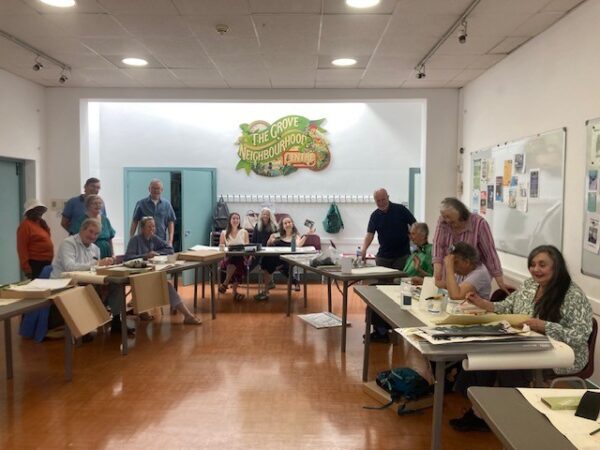
Photo shows a group of people in a large room. Each person is painting a picture.

Art for mental health

Art can benefit people’s mental wellbeing in a number of ways. According to the Mental Health Foundation, “Participating in the arts can enable people to deal with a wide range of mental ill-health conditions and psychological distress. The best part is that it helps people to improve their mental health through creativity. Making art is helping many people express themselves, without having to use words.”

Rachel shares, “One lady has just returned having had cancer and been homeless. She’s really suffered but she loves to come along, and she loves being with people, and it really, really helps her. It lifts her spirits.”

Hammersmith United Charities’ support

The Grove Neighbourhood Centre Folk Art Group has received a number of grants from us over the years, which it’s used to part-fund the cost of paying Rachel and hiring the neighbourhood centre. Carey says, “I don’t think that the group would have survived about four years ago if we hadn’t been able to get a grant.”

Thanks to our grants, the art group has been able to keep subscription costs affordable for members, some of whom would otherwise struggle to attend.

The need for the art group cannot be overemphasised. As one member says, “It’s inspiring and relaxing to make art surrounded by lovely people while having tea and biscuits!”


Abstract painting of a white dog against a green background. Find out more

The Grove Neighbourhood Centre Folk Art Group meets on Wednesday afternoons, 2.30pm – 4.30pm. Drop-ins are welcome and pay £7 – £10, depending on their income.

Grove Neighbourhood Centre
7 Bradmore Park Road,
Hammersmith, W6 0DT

“I cherish the lightness and banter between all us amateur artists; the encouragement and support from everyone has made a big difference to my confidence – and when I miss a class I really notice the difference.” A member of The Grove Neighbourhood Centre Folk Art Group

 

Stylised landscape painting done in bright colours

Flats are now available in our almshouses

If you think you might be eligible, we'd be happy to give you a tour of our almshouses and share what it's like to live here.

Read More ...
One man and two women wearing Dad's House aprons. They are all smiling and have their arms around each other.

Dad’s House

“Where there was once trauma, fear and uncertainty, we now have peace, stability, and the chance to heal.”

Back in 2008, Billy McGranaghan founded Dad’s House as a food bank for single fathers who were struggling to make ends meet. However, the charity’s remit soon expanded.  Billy explains, “I set up the food bank and not one dad turned up! So, it became a community food bank overnight.”

Today, the charity aims to support people’s emotional needs as well as their financial ones, and now offers everything from a food bank, family law clinic and dads’ support group, to guitar lessons and yoga classes.

Billy was recently awarded an MBE in The King’s New Year Honours List 2026, for his work at Dad’s House. Together with a small team of paid staff and a large team of volunteers, he’s helped some 80,000 families.

One man and two women wearing Dad's House aprons. They are all smiling and have their arms around each other.Food bank and lunch club

Every week, around 160 families rely on the food they receive from Dad’s House. As Billy says, “Everybody’s broke. The cost of living is killing everybody. Food inflation is up another 3% and it’s not going to come down.”

Alongside the food bank, Dad’s House runs a weekly lunch club, where people can come together to eat nutritious food and socialise with others who understand what they’re going through. One client shared, “On Tuesdays with Dad’s House’s weekly lunch clubs, I can leave my house and know I have somewhere to talk with other people and feel part of a community.” The club is particularly needed during the school holidays, as without free school dinners children may not always have enough to eat.

Dad’s Table

A key aim of the charity is to combat loneliness and isolation. It’s often difficult for single dads to maintain friendships and meet new people. Not many jobs allow you to work in school hours only, but lower wages don’t cover childcare costs. As a result, many of the fathers the charity supports are unable to work. They’re often isolated at home for much of their spare time, as they can’t afford to meet friends for a drink, play organised sports or invite people over for lunch.

Alongside that, as Billy explains, “A lot of the dads are going through family breakdowns; it’s probably the most difficult time in that dad’s life, and the family court system is a black hole that can last up to two years.”

Dad’s Table gives struggling dads a supportive environment to talk about the difficulties they’re facing. The mutual support group meets twice a week. As one member explains, “Dad’s Table gave me a space to express my anger, my frustration, and my sadness. But it also helped me realise that I wasn’t powerless. I started to see that there were ways I could move forward, both for myself and my children.”

Family law clinic

A pro bono family law clinic is held twice a week to support people with disputes around child arrangements. Most of the clients are either being denied contact with their children or want to put measures in place to protect them. The service receives 5,200 telephone calls and 2,500 emails per year and has directly supported more than 800 clients through the family law court.

Billy says, “Our legal director is a solicitor called Simon Bruce – one of the top financial solicitors in the country. We have a family law clinic manager, and around 10 solicitors and 50 barristers who volunteer with us. Last year, we provided £1.3 million worth of pro bono work, and that’s due to the team that we have of people who care.”

One recent client shares, “I truly appreciated Dad’s House’s unwavering focus on the children’s wellbeing. They ensured that they remained at the heart of every legal decision. Today, midway through 2025, my children and I are finally free from the court process. Where there was once trauma, fear, and uncertainty, we now have peace, stability, and the chance to heal. Looking back, I cannot overstate the impact of their work – not only in securing the right legal outcomes but also in restoring my belief in justice.”

Hammersmith United Charities’ grant

Last year, we awarded Dad’s House £7,300 to help with energy costs and to provide essential supplies for families.

Dad’s House relies on grants and donations to run the charity. Billy shares, “A lot of our funders live locally, so they’ll pop in for a cup of tea or some lunch and see what we do on a daily basis. I’m also constantly on the phone and in meetings all over London raising money.”

Support Dad’s House

Most of Dad’s House’s team are volunteers. Without volunteers, there would be no food bank, law clinic, lunch club or any of the many other services that the community rely on. If you can spare a few hours to support struggling families, visit www.dadshouse.org.uk to find out more or email info@dadshouse.org.uk.


Read More ...
Graphic says Welcoming our newest Flexible 3 Year Grant holders

Welcoming our newest Flexible 3 Year Grant holders

They've each been awarded £45,000, split over three years.

2025 was a tough year for many people. Local charities have risen to the challenge, providing basic essentials, advice and other vital support. Our Flexible 3 Year Grants are designed to offer local organisations a bit more stability so they can plan for their future and, if necessary, adapt to shifts in demand.

. Our newest grant holders are:

  • Petit Miracles
  • Shepherds Bush Families Project & Children’s Centre (SBFP&CC)
  • Active Successful Engagement (ASÉ) CIC

They’ve each been awarded £45,000, which will be split over three years.

Petit Miracles

Petit Miracles helps people to lift themselves out of poverty, by giving them the skills and confidence they need to find work or succeed as an entrepreneur. The social enterprise offers furniture restoration workshops to people who have a disability or who are otherwise disadvantaged, giving them the chance to build a new career.

It also runs a business incubator programme where people can learn business skills, network and share ideas. Members are then able to sell their products in Petit Miracles’ shop in West 12 Shopping Centre.

Founder and CEO Elisicia Moore says, “All of the circa 150 people per year who benefit from our programmes experience unemployment and social exclusion and face barriers such as disability, homelessness, mental ill-health or isolation. Our programmes have been co-designed to build the skills, experience, confidence and social integration they need to gain meaningful volunteering, further training and/or paid work.”

Petit Miracles is using its grant to help launch a new coffee bike programme, Miracle Brews, which will provide training and employment for young disabled adults.

Shepherds Bush Families Project & Children’s Centre (SBFP&CC)

SBFP&CC works with families who are experiencing significant housing difficulties. Some are homeless or at risk of homelessness. Others are living in unsuitable accommodation or struggling due to low wages. CEO Tina Mayers shares, Parents living in these situations often suffer depression and anxiety and feel guilty that they are unable to meet the needs of their children. Children and young people often miss out on the givens of normal family life. We aim to relieve the distress caused to these families and reduce the isolation and poverty most experience.”

SBFP&CC is putting its grant towards ongoing expenses and is planning to consult with parents and young people about developing new services.

You can read more about the charity in our case study.

Active Successful Engagement (ASÉ) CIC

ASÉ supports disadvantaged children and teenagers aged nine to 18, along with young adults who have SEND. Service users are experiencing a range of challenges, such as being:

  • Traumatised from past events
  • In care
  • A young carer for a family member
  • Affected by domestic abuse or gender-based violence
  • Digitally excluded
  • On a very low income

ASÉ’s work includes supporting children, young people and adults via mentoring, peer support and skills-building, tackling inequality and fostering long-term wellbeing. As Director Pauline Zepherin explains, “We empower communities, amplify under-represented voices and drive systemic change. Working with families, local authorities, schools and the NHS, we deliver culturally responsive community-led solutions that build resilience and long-term impact.”

ASÉ CIC is using its Flexible 3 Year Grant to deliver i-MATTER: Advocates for Change. 36 adult Advocates for Change Champions with lived experience of disadvantage will be trained to deliver trauma-informed mentoring, advocacy work and group support to young people and families.

Find out more about applying for a grant from Hammersmith United Charities

While our Flexible 3 Year Grants focus on organisations that we already work with, we also offer Community Grants, which are open to other charities working in Hammersmith.


Read More ...
Hammersmith United Charities' new Chair, Guy Vincent. He is a white man with a beard and moustache.

Introducing our new Chair

Guy Vincent shares his ambitions for Hammersmith United Charities.

Hammersmith United Charities' new Chair, Guy Vincent. He is a white man with a beard and moustache.Guy is a retired solicitor who has lived in Hammersmith for over 40 years. As well as having a long legal career, Guy has decades of experience in the not-for-profit sector. He was a school governor for 35 years and spent several years volunteering as Chair of the Finance Committee at Hammersmith & Fulham Law Centre. If you recognise Guy, that’s probably because he also served as a local councillor for Hammersmith & Fulham.

We spoke to Guy about why he volunteers and what he wants to achieve in his new role as Chair of Hammersmith United Charities.

Why did you apply for the role of Chair?

I’ve been very lucky to have had an interesting career and learn skills that I’m happy to still use where I can. I’ve been engaged in the community throughout my 45+ years in Hammersmith, so I know the neighbourhood well.

I gave up my other voluntary commitments a couple of years ago as we were moving house and having a lot of work done. Once we’d finished all that, I thought it would be nice to do something in the community again. I want to contribute something, not just sit with my feet up!

I was a councillor with the previous Chair, Vivienne, and heard that she was retiring from the role. From what I’ve seen so far, Hammersmith United Charities is a great organisation and run very well, so I’m really looking forward to getting started.

What are your plans now that you’ve been appointed?

It’s early days and to begin with, I’ll just be learning about the charity, understanding what can be done, and figuring out what I can contribute. I’m coming in as a stranger amongst a committee full of people who’ve been doing this for years, so I’m looking forward to getting to know people.

I’ve signed up for the Christmas dinners and plan to attend coffee mornings and things like that. People like to know who their trustees are, so I think it’s important that I’m seen around the place.

In the long term, I just want to help the charity to provide as much support to the community as it can. I’ll be working with the team – both the trustees and the management – to try to make sure that the charity prospers and continues to do great things.

It’s unlikely that we’ll be able to expand the almshouses. However, there’s a great deal of opportunity to make an impact through the grants. While the sums being given aren’t enormous, a small sum of money can have a very big impact on a small organisation.

What do you enjoy doing in your spare time?

My wife, Sarah, and I enjoy travelling by train around Europe. We’ve got more time on our hands now that we’re retired, so we can take things at a more leisurely, pleasant pace. We spend a few hours on the train, get off, stop somewhere nice, have a meander and spend the night. It’s so much nicer than flying. Italy is our favourite place to visit; we’ve been going for 40 years. We particularly love Tuscany for its lovely medieval villages, which are always a joy to visit.

We also enjoy being involved in the community. It just seems the right thing to do – work within the community, for the community.

Read More ...
A group of women standing on the steps of the Royal Court of Justice. They are wearing t-shirts saying Hammersmith Law Society.

Hammersmith & Fulham Law Centre

Providing free legal advice to those most in need


A group of women standing on the steps of the Royal Court of Justice. They are wearing t-shirts saying Hammersmith Law Society.“We recently represented a migrant woman who was trafficked to the UK by a wealthy family. She was forced to work extremely long hours as a nanny, housekeeper and cleaner. She didn’t receive anywhere near the minimum wage, and the family had control of her passport and bank account.”

This situation, shared by Sara Taylor, CEO of Hammersmith & Fulham Law Centre, is all too common. However, this particular woman went through an even worse experience. Sara explains, “The family said that she could visit her family. When she returned, not only had her employment been terminated, but she’d also been made homeless. This is a woman in her early 60s, who had been with this family, in servitude, for decades.

“When she turned up in our reception, she said, ‘When I came back, they wouldn’t let me in the house, so I’ve got nowhere to live; I don’t have my medicine; I don’t have my money; I don’t have a job; I have nothing.’ It seems an extreme situation, but it’s one that unfortunately we do come across.

“We not only assisted her with a tribunal claim against her employers for unpaid wages and damages, we also made a homelessness application and arranged for her to receive pension credit. She got her own flat and with the money she’s now received, is hoping to go back to her country of origin and retire.”

Without the Hammersmith & Fulham Law Centre, this outcome could have been very different. There is no Legal Aid for employment law advice, other than for a small area relating to discrimination, and many workers simply cannot afford to pay a solicitor.

Thankfully, Hammersmith & Fulham Law Centre offers free legal advice to people who are on a low income, including delivery drivers, nannies and factory workers.

Sara shares, “The people who come to us are facing a myriad of issues. Unfortunately, lots of people are dismissed unfairly by their employers. We also see a lot of claims for unpaid wages, holiday wages or sickness pay as, again, lots of employers don’t pay workers what they’ve earned.”

The Hammersmith & Fulham Law Centre can help with legal issues such as:

  • Being trafficked to the UK and made to work for little or no pay
  • Unfair dismissal
  • Discrimination due to a worker’s gender, religion or another protected characteristic
  • Wages being under the legal minimum
  • Unpaid holiday or sick pay
  • Reasonable adjustments not being made if a worker is disabled

Sara adds, “Some people are seeking compensation; others are trying to get their job back or to stay in their job with the adjustments that they’re entitled to. Some have agreed to leave their job and are just looking for a good reference.”

The Hammersmith & Fulham Law Centre supports clients in a number of ways. Sara explains, “We draft witness statements, accompany clients to meetings with their employer, represent them at hearings and so on. Sometimes, we’ll just spend a couple of hours with a client, going through their legal options, giving them legal advice, and then confirming all that in writing, and that’s as much as they need. Other times, we will represent them in a whole tribunal claim, from the beginning to the end.”

Hammersmith United Charites’ grant

The Law Centre helps clients with a wide range of challenges, such as being unlawfully evicted, living in an unhealthy rental property and applying for indefinite leave to remain. However, these cases are usually covered by Legal Aid, while the centre’s employment-related cases are not.

Earlier this year, we provided Hammersmith & Fulham Law Centre with a £10,000 grant. Sara says, “Without charitable grants like this, we wouldn’t have an employment law solicitor; we just couldn’t do this work. It was a really difficult situation for that client [mentioned above], but we were able to help, partly due to this grant.”

Find out more

If you’re on a low income and need legal advice, you can make an appointment with Hammersmith & Fulham Law Centre by emailing reception@hflaw.org.uk, calling 020 3880 1727 or visiting their office during working hours.

Read More ...
View More