Facebook Twitter Instagram

Celebrating National Gardening Week

You don’t need a private outdoor space to reap the many benefits of gardening.
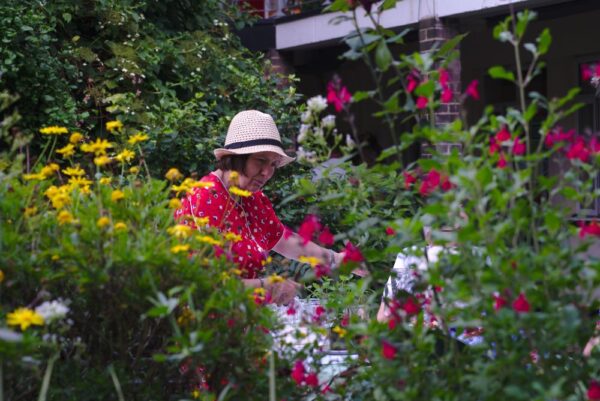
Image shows woman gardening

Organised by the RHS each year, National Gardening Week helps to raise awareness of the mental and physical benefits of gardening. Not everyone has their own private garden in Hammersmith, but most people can access a balcony, window-box or shared green space and just two hours in nature a week can improve wellbeing.

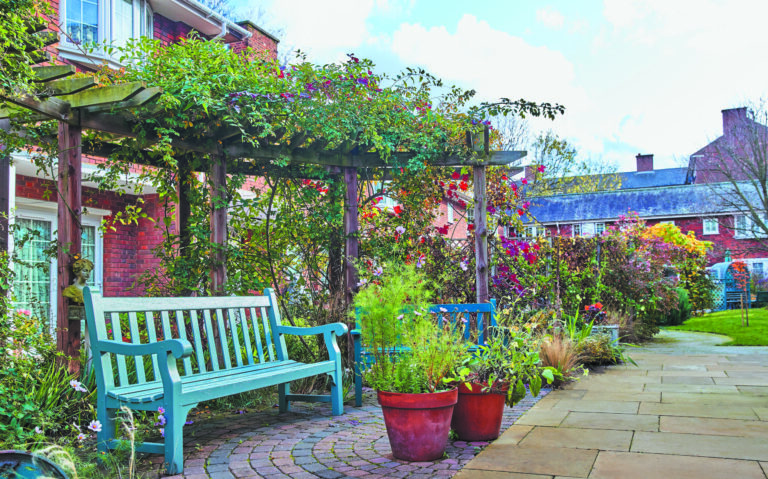
Our two almshouses – John Betts House and Sycamore House – both have large shared gardens.  They’re managed by a team of three gardeners – India, Lucy and Victoria (known as V). The gardens are much loved by the people who live here.

As one resident, Ann, shares, “The garden is wonderful and I have a gorgeous tree just outside my front door, which gives me huge pleasure. It’s a marvellous setup really – a wonderful oasis in the middle of a busy city.”

As well as the shared gardens, a few residents at Sycamore House have their own gardens. We also have four allotment beds at John Betts House and five large planters specifically for residents, most of which are used for growing vegetables. Many of the residents also keep flowerpots outside their front doors.

The benefits of gardening
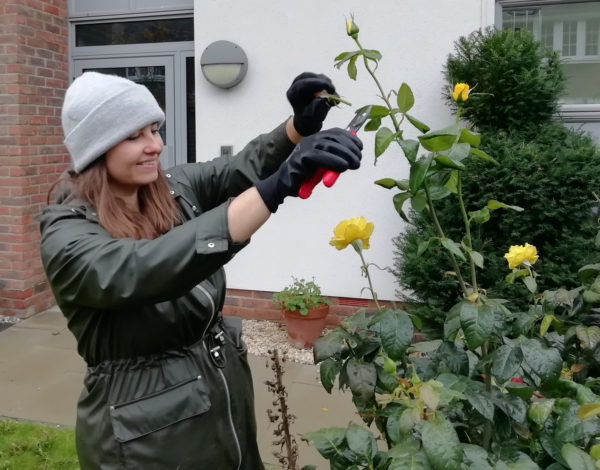
V with rosesNumerous studies have shown that gardening can be hugely beneficial for both physical and mental wellbeing. It’s a great way to keep fit and active, and can help to reduce sleep problems, stress, anxiety and depression. India says, “There’s a lot of evidence that being able to enjoy green space can help certain health conditions and increase life expectancy. I definitely believe having nature in our lives is good for wellbeing, even if you’re just walking through it, sitting outside or seeing it from your window. And the fact that residents know they can be involved in the space and take part in activities is so good for them.”

V adds, “Residents who don’t get involved in gardening still enjoy being able to see the garden and sit out in it. There’s a lot of research now showing that even just being able to see the colour green can have a positive benefit on mental wellbeing.”

Gardening for older people

Gardening can be particularly beneficial for older people, as it can help to maintain fitness levels, dexterity and independence. According to the gardening charity Thrive, “Time in nature has been shown to improve emotional state, physical health, verbal expression and memory.”

V shares, “Residents will often talk to me about a memory they have of a garden or outdoor space that they had growing up. Sometimes, there will be a particular plant that a relative loved, and so they want to put one in their pot or plant it somewhere in the garden to remind them of that person.”

Gardening together

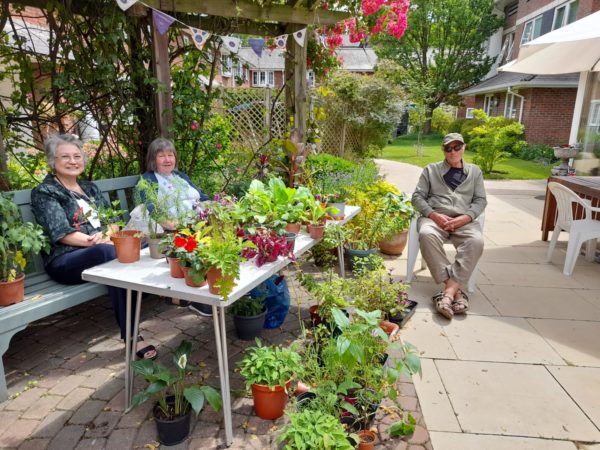
When people garden together, as is often the case at Hammersmith United Charities, it brings added social benefits. Our residents support the gardeners with a number of jobs, including watering pots and clearing leaves.

We also hold gardening workshops for residents most months. V explains, “We had a seed sowing workshop in March, and are planning a hanging basket workshop for May.”
Get involved

  • The focus of this year’s National Gardening Week is new gardeners. Whether you have a balcony, a shared garden or just fancy growing some house plants, you’ll find lots of beginner guides to help you get started at rhs.org.uk/get-involved/national-gardening-week
  • There are several community gardens dotted around Hammersmith, most of which are run by Hammersmith Community Gardens Association (HCGA) . The charity is always keen to hear from people who have time to help out. You don’t need any experience of gardening to take part.
  • Some GPs are now able to prescribe gardening instead of, or alongside, medication to ease stress, anxiety and depression. Patients are referred to a community gardening scheme, where they take part in a range of activities, from sowing seeds to pulling up weeds. Ask your GP for more information.


Flats are now available in our almshouses

If you think you might be eligible, we'd be happy to give you a tour of our almshouses and share what it's like to live here.

Read More ...
A man and a woman smiling at the camera. She is wearing a Nourish Hub T-shirt so is likely a volunteer

Nourish Hub

Reducing food waste while bringing people together

Coming together to ‘break bread’ and share a meal is an important part of many cultures. However, when friends and family live far away, communal meals can feel like a distant memory, especially when money is tight.

Nourish Hub is helping to change that, and reducing food waste in the process. Its community lunch runs five days a week. People are invited to sit down together and enjoy a freshly cooked, nutritious three-course lunch for a suggested donation of just £3 per person. In the last financial year, the charity served 33,921 meals, with the help of around 200 volunteers. Every lunch is made from ingredients that would otherwise be wasted, from wonky carrots to surplus bread.

Hub Manager Andreea Rizea says, “It’s not just about food, it’s about community building. This is a safe, inclusive and welcoming space, where people can make connections with other members of the community. There are good vibes, good people and a spirit of togetherness.”

Some of the people who come to the community lunch are otherwise quite isolated. One regular attendee shares, “Nourish Hub gets me up and gets me out of the flat. I’m able to socialise with a lot of people.”

A group of Nourish Hub volunteers and staff members in the kitchen

Tackling waste

Nourish Hub’s parent charity, UKHarvest, collects surplus food from distributors, farmers, supermarkets and hotels. The community hub also receives food from other partners, such as City Harvest and Chiswick House & Gardens, and it grows leafy greens and herbs in its own indoor growing towers.

When you consider that almost a third of greenhouse gas emissions are linked to food production and that almost 2 million tonnes of food is wasted in London every year, it’s clear that charities like Nourish Hub benefit the environment as well as people.

The Hub often receives lots of one particular type of food, whether that’s butternut squash or cabbage, so the team needs to come up with creative ways of using it. Andreea says, “Every morning is like Ready, Steady, Cook in our kitchen! There’s a lot of creativity and we’ve got a very diverse team of volunteers who all share their own recipes, so our menu changes daily.”

A man and a woman smiling at the camera. She is wearing a Nourish Hub T-shirt so is likely a volunteer

The average home wastes around £470 of food every year. There are many reasons for this, including confusion around food labels and a lack of meal planning. Andreea says, “This is an issue that we take very strongly, so alongside our community lunch, we have a very comprehensive education programme – NOURISHed. It’s delivered by our in-house nutritionist Helen and our education & events chef Tom. We teach everything from simple cutting skills to more complex recipes, and alongside that, we teach people about nutrition, budgeting and how to reduce food waste, for instance by freezing bread and milk if they’ve bought too much and making stock with vegetable peel. Last year, we delivered 265 education sessions and events through NOURISHed”

Clothing waste is another major environmental issue, so Nourish Hub has partnered with Regarm – a community clothing initiative – to redistribute pre-loved clothing for free. Each week, people can choose items of clothing that have been collected from Notting Hill Market and other areas.

The charity also runs clubs and workshops to bring people together and reduce waste. These include a sewing and clothes repair course run by La Modista, and a shared reading group.

Community pantry

This year, Nourish Hub has launched a new service – a community pantry where people make a £5 donation to fill a bag with surplus produce of their choice. Andreea says, “As well as addressing food insecurity, it’s about long-term wellbeing and dignity. There’s no eligibility criteria and we try to offer wraparound support through organisations like Citizens Advice, Shelter and Turning Point.”

Volunteer

Nourish Hub relies on a large team of volunteers, many of whom have received support from the charity themselves. Some are there to share their skills, others to gain new skills and work experience. All want to share their love of good food and give something back to their community. As one volunteer, Niall, says, “Before I came here, I was struggling with mental health problems and unemployment. This seemed like a safe environment for me to develop social skills and do what I love doing, which is cooking.”

Join in

Nourish Hub is open to everyone, whether you want to attend a free cookery class, join a book club, or take part in a community lunch. The charity is also keen to hear from people who are interested in volunteering to cook or serve meals. Find out more at www.nourishhub.org.uk or watch the video below:


Read More ...
Graphic says 13 groups have been awarded grants totalling £107,500.

February 2026 grants announced

13 groups have been awarded grants totalling £107,500.

Thousands of people in Hammersmith rely on the voluntary sector. From toddler groups to emergency food parcels, the services offered across the borough change lives.

We’ve been supporting these grassroots causes for many years, by awarding Community Grants to groups that make a tangible impact, including those working to alleviate poverty, enrich children’s lives, and help some of the most vulnerable people in Hammersmith.

Our February grants round saw 13 groups awarded a total of £107,500. These include:


Bubble & Squeak: £15,000

Bubble & Squeak takes nutritious, quality food that would otherwise be wasted, and gives it to people in Old Oak who are struggling to afford basic essentials. Recognising that working people can’t always access morning and afternoon sessions, the CIC is using its grant to open a food stall two evenings a week. Find out more about Bubble & Squeak.

1000 Black Boys: £15,000

1000 Black Boys’s grant will be spent on mentorships and activities to inspire and empower 300 Black boys, girls, young men and women. Read our case study on 1000 Black Boys.

Wendell Park Primary School: £12,900

Six Wendell Park pupils will benefit from specialist art therapy, helping them to work through trauma and other challenges. Their parents will also be supported to better understand and respond to their children’s emotional needs. Read about art therapy at Wendell Park Primary School.

The School & Family Works: £12,000

The grant will pay for a trained therapist to support eight families at Old Oak Primary School. The families will come together once a week to take part in activities, share ideas and learn from one another.

The Kulan Foundation: £10,000

Our funding is supporting the Kulan Foundation’s free homework clubs for 80 children and teenagers. It will also contribute to the cost of delivering parenting workshops and helping elderly residents. Most of the charity’s beneficiaries are from a refugee or migrant background. Read about the Kulan Foundation.

The Creighton Centre: £8,000

170 people who are living with dementia will be matched with volunteers, who will help them to stay safe and connected to their community and to access additional support where needed. Find out more about the Creighton Centre.

Hammersmith & Fulham Foodbank: £6,500

Hammersmith & Fulham Foodbank supports thousands of people in crisis every year. The charity is using its grant to provide emergency food through its Shepherd’s Bush, Old Oak and White City centres. Read about the foodbank’s work.

Lyric Hammersmith Theatre: £5,850

300 people on a low income will be able to watch a play at the Lyric and 90 young people will be able to take part in a theatre programme, with the help of our funding.

BlindAid: £5,000

BlindAid will use its grant to support 100 blind and partially sighted adults, including through home visits and regular phone calls.

Hammersmith Academy: £5,000

Many of the children at Hammersmith Academy don’t have their own garden, so the one at their school is crucial for their wellbeing. The grant will help to cover the cost of a specialist gardener. Read about how the garden has inspired a new generation of nature lovers. 

Lawyers4Learners: £5,000

330 Year 6 pupils will take part in free public speaking workshops, so that they can feel more confident in communicating their ideas and start building skills they’ll use throughout their lives.

Grove Neighbourhood Centre Folk Art Group: £2,250

The grant will fund weekly art sessions at the Grove Neighbourhood Centre. Read about the impact that the art sessions have on people’s lives, including reducing loneliness and increasing creative expression.


How to apply for a HUC Community Grant

We’re keen to hear from smaller, local organisations in our area of benefit, which have a strong connection to their community and a working knowledge of the local area. Your project can be one-off or ongoing. What interests us most is the difference you’ll make to the local people most in need.

Please complete our Eligibility Quiz before applying and then contact us at grants@hamunitedcharities.com to tell us about your project. We like to talk to applicants before you apply to get a better understanding of what you’re doing and answer any questions you may have.

Find out more

Read more about how to apply

Read More ...
Paul at the top of a mountain wearing a hat, sunglasses and a raincoat.

Age Without Limits

“I prefer the phrase ‘renaissance’ to ‘retirement’”

Ageism can be incredibly damaging. It limits older people through assumptions, not because of their actual ability. It affects how they’re treated in everyday interactions, education and the workplace, and it makes people feel devalued.

June 10th is Age Without Limits Day. The campaign by the Centre for Ageing Better aims to “create a society where everyone enjoys later life free from the impact of ageism.”

It’s a vision that’s very close to our hearts, as all our residents are over 60. Several of them are still in paid employment and many are still very active in the community in other ways, including through volunteering. As one of our residents, Siobhan, says, “Volunteering is a way of giving something back and helping others. It gives one a good feeling.”

Paul at the top of a mountain wearing a hat, sunglasses and a raincoat. Several of our team members are also over 60, including our Head of Grants and Community, Paul Robson, who joined us aged 65. He says, “I was working for Age UK, but I wanted to move to a smaller organisation with more of a local focus, where I could see the impact first hand.”

Changing jobs can be challenging at any age, but even more so when you’re approaching retirement. One in three people aged over 50 believes they’ve been turned down for a job because of their age, and the situation is likely to be even more difficult for those over 60.

As Carl Honoré wrote for Age Without Limits, “Older employees are routinely passed over for promotion, discarded first in hard times, denied training or given unfulfilling work.”

Paul says, “I did think, ‘They’re going to see from my CV how old I am, realise that I’m approaching state pension age and worry about how long I’m going to stay.’”

While ageism is a barrier at many organisations, we value experience. Paul has now been working at Hammersmith United Charities, part-time, for over three years. He’s considering stopping paid work next year when he turns 69. However, as he explains, “I prefer the phrase ‘renaissance’ to ‘retirement’. There’s this myth that as you get older, there’s an inevitable decline, and that when you stop paid work, it’s downhill, physically and mentally, from there. Losing the routine and structure of paid work does scare me a little, as does losing the sense of identity you get from paid work, but actually, this time can be really exciting.

“We all do a mixture of things throughout our lives – a bit of paid work, a bit of learning, a bit of caring for others, a bit of leisure time, maybe a bit of community work. How you balance that and use your time, effort, mental energy and physical energy, is in flux throughout your life; the size of each slice of the pie changes. There was a time when the caring slice of my pie was quite large, but now that’s smaller and I’ve slowly been reducing paid work while increasing my community work.”

Paul currently volunteers with Age UK Richmond and with Cocoon – a charity for young people leaving care. He wants to take up more volunteering opportunities once he’s finished paid work. Alongside volunteering, Paul is planning to make the most of his free time by staying physically and mentally active. Amongst other things, he wants to delve into philosophy and learn tai chi. As he says, “‘Lifelong learning’ might be a bit of a cliché, but it really is so important.”

One of Paul’s favourite pastimes is hiking in Scotland and the Lake District, particularly hill and mountain walking. “The Munros in Scotland are peaks above 3,000 feet. I’ve done around 68 of them. Some people try to climb all 282. A few years ago, a 79-year-old guy decided to do them all, and he did it in two years. I don’t think I’ll attempt that, but I do enjoy the experience of being outdoors and the physical and mental challenge of six-to-eight-hour walks, up three or four thousand feet, over 16 or so kilometres.

“I’m in a fairly privileged position in terms of health. I’ve invested in that by keeping active and through lifestyle changes, including drinking less and improving my diet.

“It’s all about investing in myself for the future.”

Read More ...
Lorraine and out scheme manager Chris, smiling at the camera. Chris' arm is around Lorraine's shoulders.

Celebrating Hammersmith’s volunteers

“You're making an impact”

Without volunteers on hand to fundraise, help with events and support service users, many charities would struggle to survive. However, volunteering doesn’t just benefit the community; it also brings with it a wealth of benefits for the volunteers themselves, from work experience and new skills, to new friendships.

While you can volunteer at any stage of your life, older people who are retired and don’t have to worry about childcare are often able to support in ways that others cannot.

One such volunteer is Lorraine, a resident at Sycamore House. Originally from Northern Ireland, Lorraine has lived in London for most of her adult life. When she retired from paid work, Lorraine started volunteering, first at Charing Cross Hospital and now for Hammersmith & Fulham Foodbank at St Simon’s Church. We spoke to Lorraine about how volunteering has enriched her retirement.

Lorraine, one of our residents

How long have you been a Hammersmith United Charities resident Lorraine?

I moved here in January 2022 and it’s been the best thing I’ve ever done in my life. I am secure here; you can take part in as much or as little as you wish, and it’s a community. Chris [our scheme manager at Sycamore House, pictured above] is just amazing, as are the rest of the staff. All my family are back home in Northern Ireland, so it’s good to have the support here as and when you need it.

I celebrated my birthday on Saturday night with a disco down in the communal lounge. It was a great night and I think I’m still getting over the effects!

What made you decide to start volunteering?

I was a key worker for young adults with learning disabilities. I thought long and hard about retiring, but I knew I couldn’t keep that work up forever. I thought, “What am I going to replace this with? Because I can’t just sit in here and tug on my thumbs!” I saw an advert at the hospital and have been volunteering for over three years now.

Can you tell us about your volunteering work?

I volunteer at St Simon’s on a Thursday. People come in with a voucher; we sit down with them and do a picking list. They get a bag of fresh food, vegetables and fruit. Some days it’s extremely busy. Other times you get a rush at the beginning and then it tapers off.

We have a hub as well where they can go and have a hot meal. They can also apply for a SIM card and we can send people to places where they can get clothes. Each week is completely different.

You get to know the clients who come in regularly, and they get to know you. If I meet them in the street, they’ll say hello. If you’re not there, then they’ll say, “Oh, we haven’t seen you for a week or two. Were you away? Are you okay?” It really shows that you’re making an impact on them and it makes you appreciate what you have yourself.

How have you benefited from volunteering?

I’ve made such a good circle of friends. We go away together. We’ve been to Harrogate and York and are planning to go to the Isle of Wight for a long weekend. They have parties in their houses and we celebrate birthdays together.

Before I started volunteering, my circle of friends was small, and it’s like a pond that has just rippled out and out. When I was at my party last week and I looked around, I really was moved, because I thought, “These are all people who are here for you – your friends, genuine friends.” It’s just wonderful.


Over to you…

Do you want to make new friends, learn new skills and give back to your community? There are hundreds of volunteering opportunities available across Hammersmith. You could help with admin, fundraising, packing food boxes or supporting vulnerable adults or children. Most community organisations rely on volunteers, so just get in touch to offer your support, or search for opportunities at www.linkuplondon.org

Read More ...
View More