The School & Family Works
Bringing parents, teachers and mental health experts together to support children.
Children thrive when the adults surrounding them work together to meet their needs. This wider support network is even more crucial for children who are struggling.
Mark Griffiths is the founder and CEO of The School & Family Works – a charity supporting vulnerable children at 12 London schools, including Old Oak Primary School. He says, “It’s about getting the right people in the room – the child, the parent, the school representative and a mental health expert – who all work together as a community over time. Together, they intentionally set about righting something that has gone off kilter.”
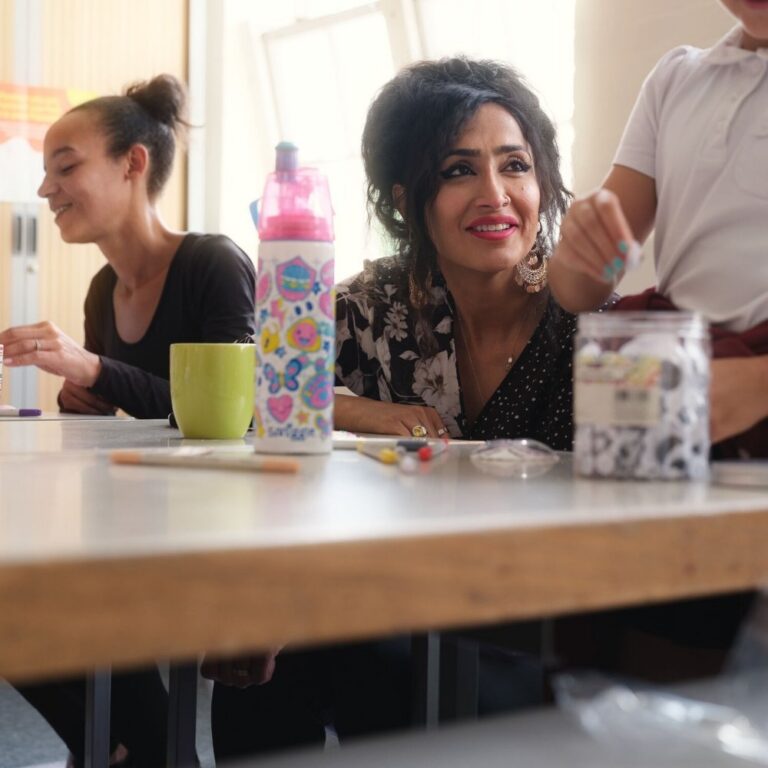
Rather than support individual families in silo, the charity brings eight families together at a time for Family Group, led by a trained therapist. It’s a safe space where children and adults can discuss challenges, offer mutual support and advice, and celebrate achievements.
Mark explains, “It’s about welcoming people, not judging them. Parents want to support their children, but they don’t necessarily have the models for that. If you can engage people who have shared aims, and they’re honest and committed, then those multiple perspectives can be a real bonus. Families help families.”
Some of the children who come to Family Group have had adverse childhood experiences, as have their parents, and they’re often disadvantaged in a number of other ways. Mark says, “Life is really hard for these families. We see poverty and discrimination. Children fall through the gaps and can be blamed for the difficulties that they’re presenting, when actually their behaviour is just a manifestation of the difficulties in the wider systems around them. If we can enable change in the system – the school system, the family system, and the relationship between those two systems, then lots of new possibilities open to that child, and they’re no longer locked in this particular way of responding.”
The group may talk about challenges that the children are experiencing, such as difficulty regulating their emotions, and discuss coping mechanisms and tools that the children and their families can use. Mark adds, “We’ll discuss things that have happened that week, why they happened and what could be done differently next time.”
As one child shares, “What’s made it work? Telling people what our problems are instead of leaving them behind and making it worse. You tell someone what your problems are and they get solved. We help other people by telling them stuff they can do. You learn about yourself.”
As the child learns, so too do the parents/carers. They’re able to reflect on their own parenting style, break generational patterns that they may not have realised they were holding onto, grow in confidence and build closer bonds with their children.
The adults stay in the group for around 45 minutes after the children have gone back to class, so they can reflect on the session. As trust within the group increases, a parent may feel safe enough to open up about a challenge that they have experienced, such as something that happened in their own childhood, which is impacting their parenting. Mark explains, “Isolation is a really common feature and sometimes parents have experiences that they can’t really talk about outside of the group. As one person shares, another shares and it creates a feeling of safety where people can articulate their experiences and be listened to.”
One Family Group parent says, “I cannot express well enough in words how much good it has done me, sharing wisdom, companionship, experiences, strategies, grief, fears and laughs in such a close, open, honest, nurturing and safe environment.”
Family Group isn’t a quick fix. It requires time, commitment and willingness from each child’s parents/carers. The average length that a family stays in a group is 18 months. When they feel ready to move on, they can, if they wish, join a Parent Graduate Group and continue to receive mutual peer support. A new family will then join the Family Group, benefitting from the experience of families who are further along their journey.
While the group’s members change, the therapist stays the same. Mark says, “We build this sense of safety and community, offer that experience of belonging, and deliver it consistently. You can’t create that kind of level of relational safety without consistency because people will only learn to trust in you over time.”
The benefits of the style of therapy offered by Family Group are numerous. Children learn to better understand and regulate their feelings. At the same time, parents learn tools for guiding their children. As a result, the key relationships in the child’s life, with parents/carers, siblings, teachers and peers, improve. The child gains confidence, and they feel happier, less anxious and more settled. Their school attendance often improves, and they have greater motivation and higher aspirations.
You can hear from the children just how much Family Group helps them by watching this video:
Hammersmith United Charities grants
The School & Family Works recently received a £12,000 grant to help fund its work at Old Oak Primary School. If you want to apply for a grant for your community organisation, you can find out more here. Please complete our Eligibility Quiz before applying and then contact us at grants@hamunitedcharities.com to tell us about your project.
- Read our grants FAQs
- Hear from other organisations we’ve supported
Find out how to apply


 i-MATTER: Health & Wellbeing & Tackling Inequalities