Mental health trauma is the unseen side of domestic abuse
Women who experience domestic abuse are twice as likely to experience depression as those who don’t.
UNiTE to End Violence against Women is an annual campaign led by the UN. The campaign kicks off on 25th November – the International Day for the Elimination of Violence against Women – and runs until Human Rights Day on 10th December.
Most violence against women is committed by the woman’s husband or other intimate partner. It happens in every country across the globe; 1.4 million women in the UK experience domestic abuse each year and, on average, one woman is killed by a male partner or ex-partner every week.
However, even more worrying are stats from the UK’s police chiefs – which point to more women affected by domestic abuse taking their own lives than were murdered by a partner or former partner. Yet there is very little awareness of or discussion around what is arguably a secondary and largely invisible impact on women.
That’s where organisations like Woman’s Trust come in. Set up almost 30 years ago, Woman’s Trust has an exclusive and specialist focus on providing free mental health care to address the trauma caused by domestic abuse and the effect this has on women in their daily lives – often going undiagnosed for years, sometimes even decades after the relationship has ended.
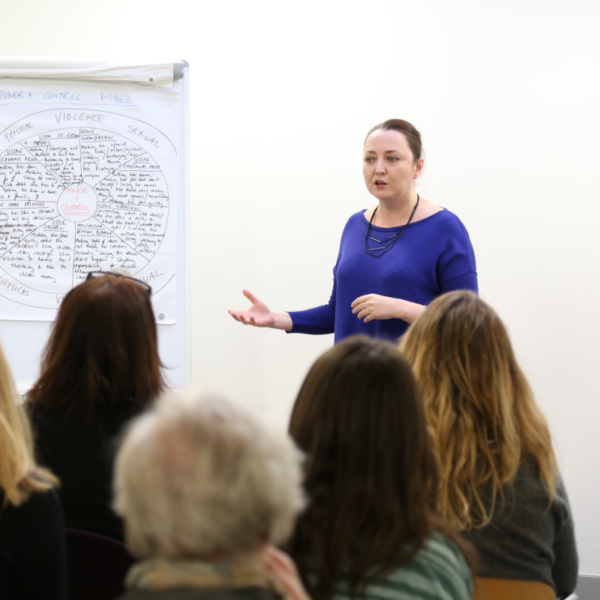 Woman’s Trust has received a number of grants from us since 2012. The London-based charity has supported tens of thousands of women with free therapy and counselling and has been a literal lifesaver for women at some of the most desperate times of their lives.
A client of Woman’s Trust shared, “My experience getting help and support from Woman’s Trust was invaluable. I was not in a good place and didn’t know that I was in an abusive relationship for all those years and what was abusive about it. When it’s psychological abuse, it’s very difficult to decipher. WT helped me to see things and to understand what was happening to me, which made me understand why I have been feeling so depressed for so many years.”
Rachel Prescott-Smith is Head of Fundraising at Woman’s Trust. She told us, ‘‘Domestic abuse still carries shame and stigma (which it shouldn’t) and as a result, many women don’t like to talk about it, and worryingly some don’t even recognise their experiences as abuse. Most people also don’t really consider the resulting trauma and mental health issues that experiencing domestic abuse can cause, even though one in two women’s suicide attempts are linked to their experiences of abuse. Raising awareness is so important, as it helps survivors know they are not alone, and that help is out there.”
According to Rachel, there are still many misconceptions around domestic abuse, from what it entails to how likely it is to happen and the way it affects survivors on a practical and emotional level. Many people don’t realise that the term ‘domestic abuse’ covers a wide range of abusive behaviour, from physical violence to economic control and psychological abuse.
Women who experience domestic abuse are twice as likely to experience depression as those who don’t, and it can take a long time to process the trauma – or even recognise that mental health challenges are caused by domestic abuse. Counselling is invaluable, but it’s difficult to access on the NHS and even more rare to get specialists who understand the unique ways in which survivors are affected, which is why charities like Woman’s Trust are so important.
Rachel shares, “If you’ve experienced domestic abuse and live in one of the areas that we work in, we can offer you up to 18 sessions with a counsellor. You’ll see the same counsellor, at the same time each week, so that you can build rapport and feel more comfortable. Sessions are completely confidential and can be online or face-to-face in a women-only setting.”
Get support
If you’re experiencing (or have experienced) domestic abuse, and you want to find out about counselling sessions in London, contact Woman’s Trust on:
(Office hours: Mon-Fri, 9:30am – 5pm)
If you want to make a professional referral for someone under your care or supervision, call Woman’s Trust on 020 7034 0303.
For immediate advice or support, please call the National Domestic Abuse Helpline on 0808 2000 247.
Angelou is a partnership of West Central London services that support women and girls affected by domestic violence and abuse. You can call Angelou for free on 0808 801 0660, email angelou@advancecharity.org.uk or visit www.angelou.org to find out more.
If you’re a man experiencing domestic abuse, call Respect’s Men’s Advice Line on 0808 8010327, email info@mensadviceline.org.uk or visit www.mensadviceline.org.uk. The ManKind charity can also help you to escape an abusive situation.






 Food bank and lunch club